
A Brief History of the Eugenics Movement in America, "...or, The scientific production of human thoroughbreds"
The so-called eugenic marriage of today is a happy combination of the ideality of a stockyard with the practicality of a hummingbird. - Dr. Edward Earle Purinton
Eugenics: "the practice or advocacy of controlled selective breeding of human populations (as by sterilization) to improve the population genetic composition" (Merriam-Webster).
In the early 20th century, the Eugenics Movement, which originated in Victorian England based on the theories of polymath Francis Galton (1822-1911), established itself in the United States. The movement was influential until the World War II era when Adolf Hitler and the Nazi party justified its murderous policies with eugenics theories.
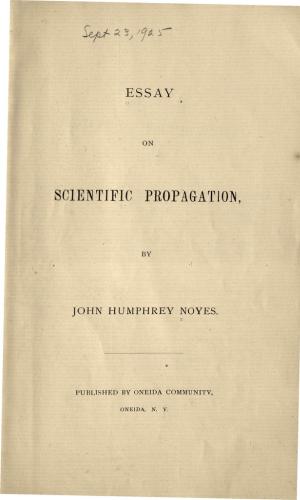
Before Galton coined the term "eugenics," John Humphrey Noyes (1811-1886) – a man of many parts: preacher, utopian, radical, and founder of several experimental communities – published a pamphlet titled Essay on Scientific Propagation (1875). He espoused views that anticipated those of the Eugenics Movement:
Phrenologists, popular physiologists and reformers of various kinds have long been busy carrying over the laws of Darwin into the public conscience, translating analogy into application; and it is remarkable how common it has become for books and newspapers to acknowledge the duty of scientific propagation [eugenics], and confess that in this matter "we are all miserable sinners."
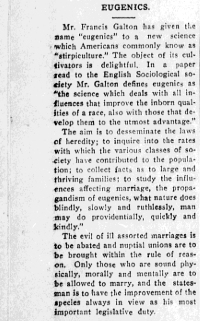
Influenced by the theories proposed by Noyes and Galton, Americans embraced eugenics. On August 9, 1904, the Bellingham Herald [Washington] published a typically positive endorsement:
The evil of ill assorted marriages is to be abated and nuptial unions are to be brought within the rule of reason. Only those who are sound physically, morally and mentally are to be allowed to marry, and the statesman is to have the improvement of the species always in view as his most important legislative duty.
Portland, Oregon appears to have been a hotbed of eugenics enthusiasm. The Oregonian reported on the annual Homeopath Medical Society convention in its July 9, 1905, issue:
Dr. Ella K. Dearborn, under the general head of eugenics or race improvement... [gave] some very pronounced ideas on the subject. "None of my ideas are new... They have been advanced in various garbs many times, but the world is not yet ready for them. There will come a time when just such theories as I have advanced today will be accepted as the only safeguard for improvement of the race."
Dr. Dearborn considered her subject under three heads, taking first euthanasia. She considers that for the proper perpetuation of the human race it is necessary to do away with criminals, degenerates and the insane. For this easy death she deemed chloroform the best remedy. Dearborn went on to propose a medical board of examiners which would decide who could be permitted to propagate and who should not. The latter were to be "submitted to artificial sterilization."

Homeopaths were numerous among the eugenicists as were animal breeders and sociologists. Examples of successful domestic animal breeding were hailed as evidence of its applicability to humans.
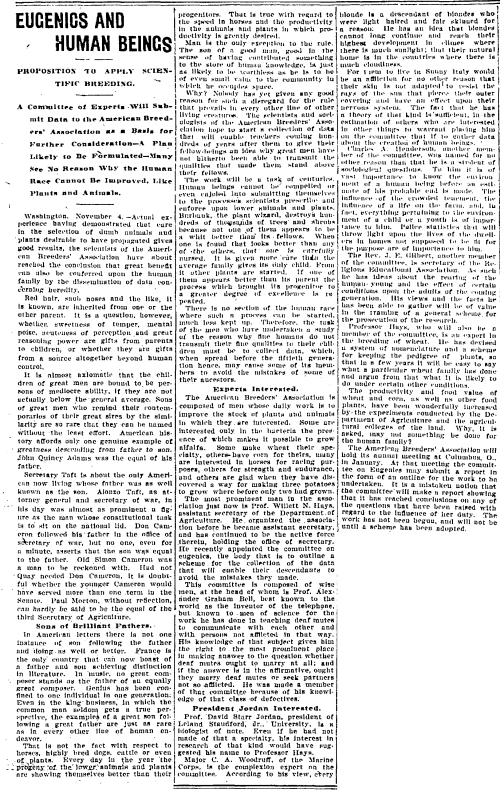
Under the headline, "Eugenics and Human Beings Proposition to Apply Scientific Breeding," the November 5, 1906, edition of the Baltimore American reported that the American Breeders' Association has formed a committee of experts tasked with determining how best to collect and disseminate data concerning human heredity. A sub-headline confirms the connection to animal breeding, "Many See No Reason Why the Human Race Cannot Be Improved, Like Plants and Animals."
Dr. Eugene Davenport, of the University of Chicago, spoke at "...one of the largest meetings of Chicago physicians in the history of the city for the discussion of the problems of heredity." This event was reported by the Daily People [New York City, New York] on January 29, 1909:
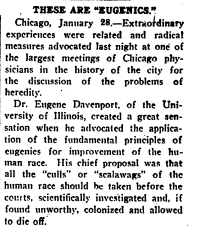
Extraordinary experiences were related and radical measures advocated last night... [Davenport] created a great sensation when he advocated the application of the fundamental principles of eugenics for improvement of the human race. His chief proposal was that all the "culls" or "scalawags" of the human race should be taken before the courts, scientifically investigated and, if found unworthy, colonized and allowed to die off.
Many progressive people were drawn to eugenics perhaps because of their idealism and belief in the improvement of society. Mrs. Helen La Reine Baker was one such advocate as reported by The Grand Forks Daily Herald [North Dakota] on December 26, 1909:
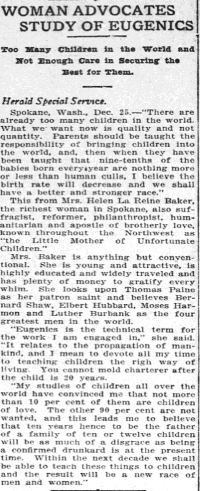
"There are already too many children in the world. What we want now is quality and not quantity. Parents should be taught the responsibility of bringing children into the world, and, then when they have been taught that nine-tenths of the babies born every year are nothing more or less than human culls, I believe the birth rate will decrease and we shall have a better and stronger race."
This from the richest woman in Spokane, also suffragist, reformer, philanthropist, humanitarian and apostle of brotherly love, known throughout the Northwest as "the Little Mother of Unfortunate Children."
"My studies of children all over the world have convinced me that not more than 10 per cent of them are children of love. The other 90 per cent are not wanted, and this leads me to believe that ten years hence to be a father of ten or twelve children will be as much of a disgrace as being a confirmed drunkard is at the present time. Within the next decade we shall be able to teach these things to children and the result will be a new race of men and women."
Her words are hard-edged, but her program seems relatively benign compared to many others.
Emma Goldman was not benign. Her views were made clear in the March 9, 1910, issue of the Pawtucket Times [Rhode Island]:
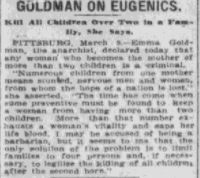
Emma Goldman, the anarchist, declared today that any woman who becomes the mother of more than two children is a criminal. "Numerous children from one mother means stunted, nervous men and women. From whom the hope of a nation is lost... The time has come when some preventive must be found to keep a woman from having more than two children... I may be accused of being a barbarian, but it seems to me that the only solution of the problem is to limit families to four persons and, if necessary, to legalize the killing of all children after the second born."
A month after Goldman's astonishing prescriptive, Francis Galton posted a rather different theory of family size. The Patriot [Harrisburg, Pennsylvania] reported his opinions on April 18, 1910. Galton proposed that regarding British aristocracy:
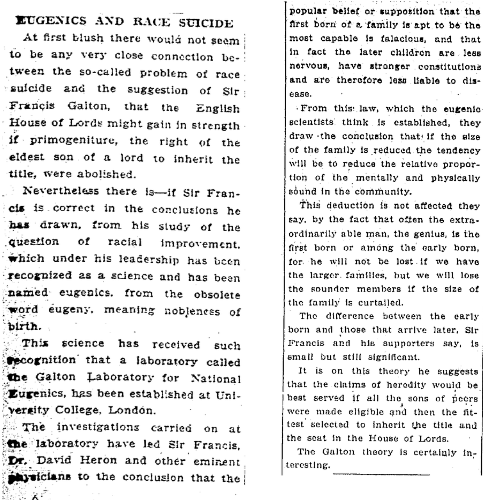
[The] English House of Lords might gain in strength if primogeniture, the right of the eldest son of a lord to inherit the title, were abolished...
The investigations carried on at the laboratory have led Sir Francis, Dr. David Heron and other eminent physicians to the conclusion that the... supposition that the first born of a family is apt to be the most capable is fallacious, and that in fact the later children are less nervous, have stronger constitutions and are therefore less liable to disease.
From this law, which the eugenics scientists think is established, they draw the conclusion that if the size of the family is reduced the tendency will be to reduce the relative proportion of the mentally and physically sound in the community.
Dr. Woods Hutchinson was a widely published writer on health and a professor of anatomy. He deplored vegetarianism and trumpeted the benefits of barely cooked beef, bacon and eggs every morning, white bread, and adipose tissue.
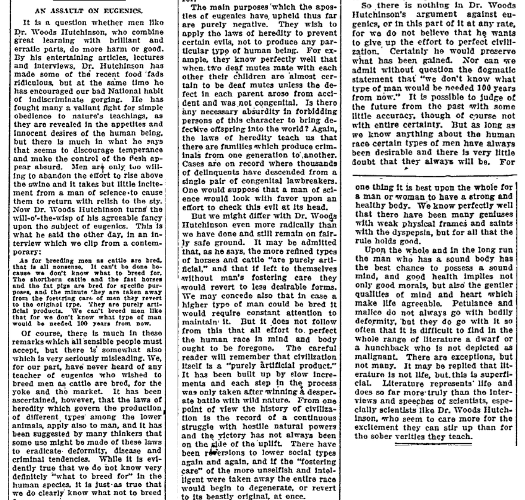
The Oregonian published an article on November 18, 1911, about Hutchinson under the headline "An Assault on Eugenic":
It is a question whether men like Dr. Woods Hutchinson, who combine great learning with brilliant and erratic parts, do more harm or good. By his entertaining articles, lectures and interviews, Dr. Hutchinson has made some of the recent food fads ridiculous, but at the same time he has encouraged our bad National habit of indiscriminate gorging... there is much in what he says that seems to discourage temperance and make control of the flesh appear absurd. Men are only too willing to abandon the effort to rise above the swine and it takes but little incitement from a man of science to cause them to return with relish to the sty [sic].
Hutchinson argued that humans could not be bred like animals because "we don't know what type of man would be needed 100 years from now." He explains that if specially bred pigs are released "from the fostering care of men they revert to the original type." He asserted that the only way to achieve a more perfect man was strict adherence to his dietary nostrums.
The article's author argues strenuously that to date eugenicists wanted only to breed out undesirable traits such as blindness, idiocy, and feebleness. He defends this position with dubious reasoning:
Upon the whole and in the long run the man who has a sound body has the best chance to possess a sound mind, and good health implies not only good morals, but also the gentler qualities of mind and heart which make life agreeable. Petulance and malice do not always go with bodily deformity, but they do go with it so often that it is difficult to find in the whole range of literature a dwarf or a hunchback who is not depicted as malignant.
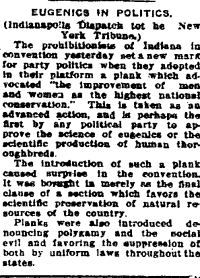
The widening embrace of eugenics was taken up by the prohibitionist party in Indiana according to an item in the Columbus Ledger on June 3, 1912:
The prohibitionists of Indiana in convention yesterday set a new mark for party politics when they adopted in their platform a plank which advocated "the improvement of men and women as the highest national conservation." This is taken as an advanced action, and is perhaps the first by any political party to approve the science of eugenics or the scientific production of human thoroughbreds.
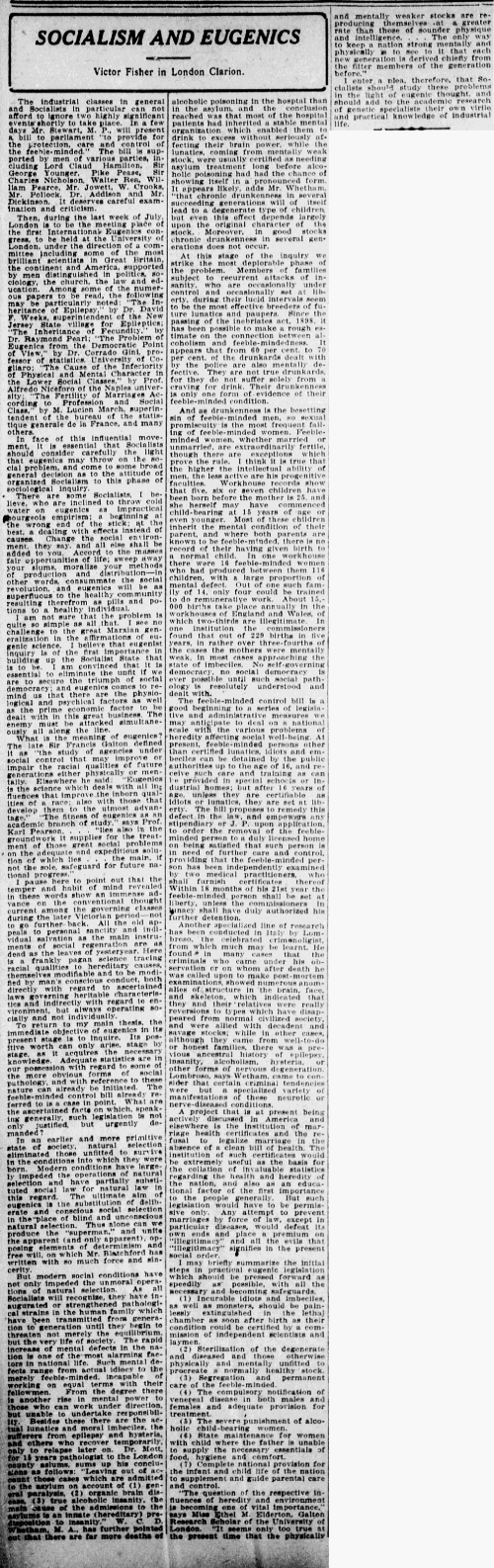
An article from the weekly socialist newspaper The Clarion [London, England] was reprinted in The State [Columbia, South Carolina] on July 1, 1912, titled "Socialism and Eugenics." The author, Victor Fisher, argued against those socialists who spurned eugenics in favor of improving the social environment. He supported a bill in Parliament "to provide for the protection, care and control of the feeble-minded."
He appears to have drawn sweeping conclusions about the so-called "feeble-minded":
And as drunkenness is the besetting sin of feeble-minded men, so sexual promiscuity is the most frequent failing of feeble-minded women. Feeble-minded women, whether married or unmarried, are extraordinarily fertile, though there are exceptions which prove the rule... In one workhouse there were 16 feeble-minded women who had produced between them 116 children, with a large proportion of mental defect.
Fisher outlined "the initial steps in practical eugenic legislation":
Incurable idiots and imbeciles, as well as monsters, should be painlessly extinguished in the lethal chamber as soon after birth as their condition could be certified by a commission of independent scientists and laymen.
Sterilization of the degenerated and diseased and those otherwise physically and mentally unfitted to procreate a normally healthy stock.
He had more ideas including the "Segregation and permanent care of the feeble-minded," and "The severe punishment of alcoholic child-bearing women."
He concludes with a plea that Socialists should study these problems in the light of eugenic thought and should add to the academic research of genetic specialists their own virile and practical knowledge of industrial life.
On March 5, 1913, the Evening News [San Jose, California] published an opinion piece by Professor Ward of Brown University. He had strong opinions against eugenics:
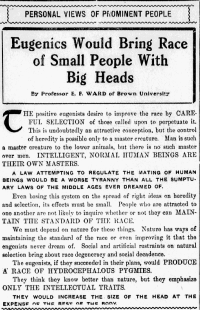
A Law attempting To Regulate the Mating of Human Beings Would Be A Worse Tyranny Than All The Sumptuary Laws of The Middle Ages Ever Dreamed Of.
People who are attracted to one another are not likely to inquire whether or not they can MAINTAIN THE STANDARD OF THE RACE.
The eugenists [sic], if they succeeded in their plans, would PRODUCE A RACE OF HYDROCEPHALUS PYGMIES.
The Boston Journal announces on July 26, 1913:
Eugenics Win in Wisconsin
Legislature also Passes Sterilization Bill for Defectives
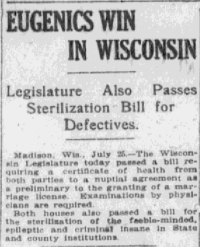
The article continues:
The Wisconsin Legislature today passed a bill requiring a certificate of health from both parties to a nuptial agreement as a preliminary to granting of a marriage license. Examinations by a physician are required.
Both houses also passed a bill for the sterilization of the feeble-minded, epileptic and criminal insane in State and county institutions.
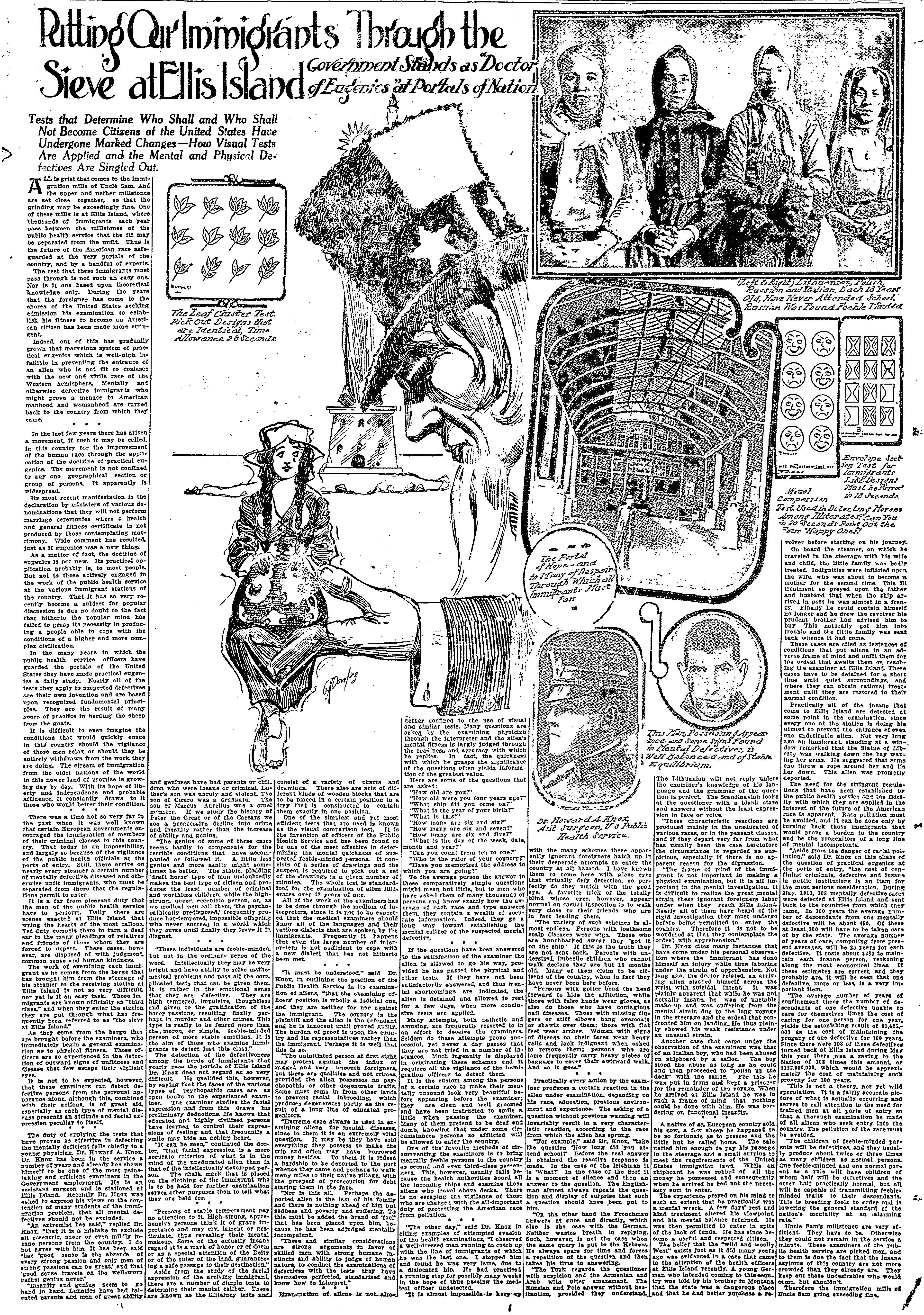
On September 28, 1913, the Oregonian published a lengthy, illustrated article headlined "Putting Our Immigrants through the Sieve at Ellis Island. Government Stands as 'Doctor of Eugenics' at Portals of Nation."
The author cannot restrain his enthusiasm for the effectiveness of the "sieve" which he describes as:
...that marvelous system of practical eugenics which is well-nigh infallible in preventing the entrance of an alien who is not fit to coalesce with the new and virile race of the Western hemisphere. Mentally and otherwise defective immigrants who might prove a menace to American manhood and womanhood are turned back to the country from which they came.
Dr. Howard A. Knox was a physician at Ellis Island in the 1910s, a time when emigrants faced increased scrutiny. Dr. Knox developed a series of tests to evaluate intelligence. He is credited with taking cultural and geographic differences into account. But the intelligence evaluations grew out of eugenics theories. He asserted that "...each type of mental disease presents an attitude and facial expression peculiar to itself."
Knox was adamant that
Insanity and genius seem to go hand in hand. Lunatics have had talented parents and men of great ability and gentlemen have had bad parents or children who were insane or criminal... The genius of some of these cases [Luther, Cicero, Peter the Great, the Caesars] seems hardly to compensate for the terrible conditions that have accompanied or followed it. A little less genius and more sanity might sometime be better.
He preferred
The stable, plodding "draft horse" type of man [who] undoubtedly makes the best type of citizen and produces the least number of criminal and worthless children, while the high-strung, queer, eccentric person, or, as we medical men call them, "the psychopathically predisposed," frequently produce hot-tempered, impossible offspring who never succeed in a world which they curse until finally they leave it in disgust.
Knox pontificates at length throughout the article. He propounds many unsubstantiated and sweeping certainties such as those already quoted. He frets about "the dangers of racial pollution." He predicts that "In 100 years the average number of descendants from one mentally defective will be about 450."
Alexander Graham Bell wrote:
The whole subject of eugenics has been so much associated in the public mind with fantastic and impracticable schemes for restricting marriage and preventing the propagation of undesirable characteristics. So that the very name "eugenics" suggests to the average mind insanity, feeblemindedness, etc., and an attempt to interfere with the liberty of the individual in his pursuit of happiness in marriage.
This and his other opinions on the subject were included in an article he wrote for World's Work and was reprinted by the Grand Forks Daily Herald on December 10, 1913.
He asserted that "cacogenics," which the Collins English Dictionary defines as "the study of the operation of factors that cause degeneration in offspring," or in other words, focusing on inheriting "the superior element," is the logical approach to producing "prepotent stock" over eugenics practices:
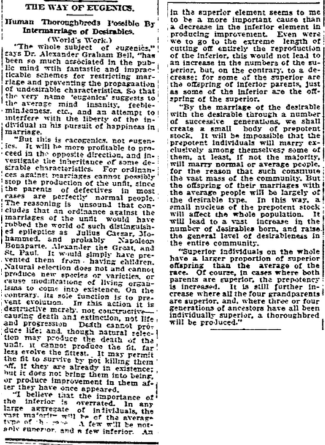
It will be more profitable to proceed in the opposite direction, and investigate the inheritance of some desirable characteristics. For ordinances against marriage cannot possibly stop the production of the unfit, since the parents of defectives in most cases are perfectly normal people. The reasoning is unsound that concludes that an ordinance against the marriages of the unfit would have robbed the world of such distinguished epileptics as Julius Caesar, Mohammed, and probably Napoleon Bonaparte, Alexander the Great, and St. Paul. It would have simply prevented them from having children...
I believe that the importance of the inferior is overrated. In any large aggregate of individuals, the vast majority will be of the average type. A few will be notably superior and a few inferior. An increase in the superior element seems to me to be more important than a decrease in the inferior element. Even were we go to the extreme length of cutting off entirely the reproduction of the inferior, this would not lead to an increase in the numbers of the superior, but, on the contrary, to a decrease; for some of the superior parents, just as some of the inferior are offspring of the superior.
Bell goes further on the development of a
...prepotent stock which will affect the whole population... Superior individuals on the whole have a larger proportion of superior offspring than the average of the race. Of course, in cases where both parents are superior, the prepotency is increased. It is still further increase[d] where all four grandparents are superior, and, where three or four generations of ancestors have all been individually superior, a thoroughbred will be produced.
His ideas seem relatively benign but leave open the definition of "the inferior" and the "superior."
In time, the eugenics excitement began to fade, but not before many marginalized Americans were sterilized, segregated, or deprived of their civil rights, and Hitler used eugenics to justify the atrocities committed by the Nazis in the 1930s and 40s.
While the violations committed by eugenicists seem long ago, contemporary scholars like Mercedes de Guardiola remind us why history matters - "Forgetting or ignoring eugenics further allows eugenicists' work to fester by precluding any attempt to address its impact." *
Study the scientific and ethical debates of past generations in Early American Newspapers, 1690-1922.
* Kevin O'Connor. "A Vermont eugenics historian repeatedly hears 'What is the relevance today?' A new book offers an answer." VT Digger, November 7, 2023. https://vtdigger.org/2023/11/07/a-vermont-eugenics-historian-repeatedly-hears-what-is-the-relevance-today-a-new-book-offers-an-answer/. Accessed October 16, 2024.