Overview
Readex Text Explorer (RTE) is a text and data analysis tool integrated across nearly all Readex primary source collections. It enables researchers and students to identify patterns, themes, and language trends within historical texts, revealing insights that may not be visible through traditional reading alone.
Designed for both digital humanities research and teaching, RTE combines computational textual analysis with an intuitive workflow so scholars can explore large bodies of text directly within Readex collections.
What Is Readex Text Explorer?
An integrated digital humanities tool for textual analysis that allows researchers to build custom corpora from Readex collections and analyze them using interactive visualizations.
The platform incorporates Voyant Tools, a widely used text analysis environment in digital humanities, combined with Readex’s integrated workflow for working with historical documents.
The result is a seamless research experience where scholars can move from discovering primary sources to analyzing them at scale.
Search across Readex primary source collections
Select documents to create a research corpus
Run text analysis tools to reveal patterns and trends
Visualize results through dashboards and graphs
Export findings for research papers and presentations
Benefits for Libraries and Researchers
Extend the value of Readex primary source collections with analysis-ready research workflows.
Deeper Historical Insights
Identify patterns and themes across large bodies of text.
Integrated Research Workflow
Move seamlessly from discovery to analysis.
Support for Digital Humanities
Conduct sophisticated textual analysis without specialized programming skills.
Classroom Applications
Provide students with hands-on experience using digital research tools.
Expanded Discovery
Reveal new perspectives on historical texts and cultural discourse.
Why Text Analysis Matters for Historical Research
Historians and literary scholars traditionally analyze texts through close reading. Text analysis tools complement this approach by enabling scholars to explore large collections of documents computationally.
Using Readex Text Explorer, researchers can:
- Detect patterns across thousands of documents
- Track word usage or thematic trends over time
- Identify relationships between ideas, authors, or publications
- Compare discourse across different sources
These methods allow scholars to “see into the texts” and uncover linguistic or thematic patterns that might otherwise remain hidden.
For fields such as history, literature, cultural studies, and digital humanities, text analysis provides a powerful way to interpret primary sources at scale.
Key Features
Integrated Text & Data Analysis
Readex Text Explorer works directly within Readex collections, enabling researchers to move seamlessly from searching documents to analyzing them.
Key analysis tools include:
- Word frequency analysis
- Phrase and syntax exploration
- Word clouds and visualization tools
- Trend graphs showing changes over time
- Tools for refining and reanalyzing corpora
These capabilities help scholars quickly identify themes, patterns, and anomalies within historical texts.
Flexible Corpus Creation
Researchers can build custom datasets by selecting documents from search results and combining them into a corpus for analysis.
This allows scholars to:
- Study the works of a specific author
- Analyze coverage of historical events across publications
- Compare discourse across time periods
- Examine language related to social or political topics
Users can revise their corpus and rerun analyses as their research evolves, supporting iterative exploration and hypothesis testing.
Interactive Visualizations
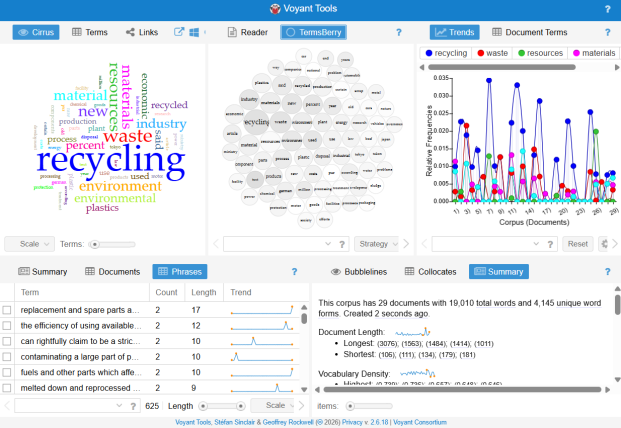
Readex Text Explorer provides a dashboard with interactive visualizations that make complex textual patterns easier to understand.
Visual tools include:
- Word clouds highlighting prominent terms
- Trend graphs showing term frequency across documents
- Phrase analysis panels
- Bubble charts and additional visualizations for exploring relationships
These visual tools allow researchers to interpret large datasets quickly and identify patterns in historical language.
Readex Text Explorer in Academic Research [Case Study]
Text analysis is central to digital humanities research, allowing scholars to study patterns across large textual datasets.
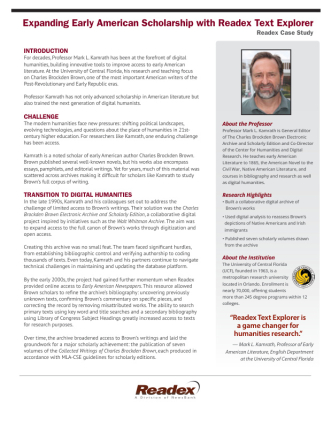
Professor Mark L. Kamrath of the University of Central Florida used Readex Text Explorer alongside Early American Newspapers, 1690-1922 to analyze literary and public discourse surrounding early American author Charles Brockden Brown.
Using the tool, he was able to:
- Detect patterns in how Brown referred to Irish immigrants
- Compare these literary depictions with contemporary newspaper discourse
- Use sentiment analysis and word frequency to identify broader patterns of meaning
According to Kamrath, digital analysis of archival materials can map “textual traces of sentiment or ideology into larger patterns of meaning.”
This type of research demonstrates how digital tools can expand traditional scholarship and generate new interpretations of historical sources.
Readex Text Explorer in the Classroom
Readex Text Explorer supports faculty teaching digital humanities methods and information literacy.
Using the tool, students can:
- Learn digital research techniques
- Explore primary sources in new ways
- Develop critical thinking about historical texts
- Practice computational analysis methods
Students can build their own corpora from Readex collections and analyze them using word clouds, frequency measures, and other visualization tools.
For many courses, Readex Text Explorer functions as a digital laboratory, where students can test ideas, experiment with textual analysis, and gain hands-on experience with digital research tools.

How It Works
The workflow is designed to make text analysis accessible to scholars and students alike.
- Search Readex collections to identify relevant texts
- Select documents to create a research corpus
- Launch Readex Text Explorer from the results list
- Analyze patterns and themes through interactive visualizations
- Export results for research papers, presentations, or further analysis

Frequently Asked Questions About Readex Text Explorer
What is Readex Text Explorer?
Readex Text Explorer is a digital humanities tool that allows researchers to analyze large collections of historical texts. It helps scholars identify patterns, trends, and themes within primary source materials using computational text analysis and visualization tools.
What types of sources can be analyzed with Readex Text Explorer?
Readex Text Explorer works across nearly all Readex collections, including historical newspapers, periodicals, government documents, and other primary sources. This allows researchers to analyze large corpora of historical texts within the same platform used to discover them.
How does text analysis help historical research?
Text analysis allows scholars to study patterns across many documents at once. Researchers can track word usage, detect themes, identify linguistic shifts, and compare discourse across time periods or publications. These methods complement traditional close reading and can reveal insights that may otherwise remain hidden.
Do researchers need programming skills to use Readex Text Explorer?
No. Readex Text Explorer is designed to be accessible to researchers and students without programming experience. The platform provides an intuitive interface with visual analysis tools such as word clouds, trend graphs, and phrase analysis panels.
How is Readex Text Explorer used in teaching?
Faculty use Readex Text Explorer in digital humanities and information literacy courses. Students learn how to build research corpora, analyze patterns in primary sources, and interpret visualizations. These activities help develop digital research skills while engaging directly with historical documents.
What makes Readex Text Explorer different from other text analysis tools?
Readex Text Explorer is integrated directly with Readex primary source collections. Researchers can move seamlessly from discovering documents to analyzing them without exporting data or using external software, making the research workflow faster and more efficient.