
Sorry, you need to enable JavaScript to visit this website.
Skip to main content

"...the malignancy of others compels us to convince the Public...": Fierce competition between innkeepers hosting stagecoach stops plays out in print

Posted on 04/09/2026
by


Ambitious inn and tavern owners in the early 1800s understood the profitability of hosting reputable stagecoach lines. Hungry, tired travelers delivered to your doorstep are ideal clientele. One might imagine an innkeeper going to great lengths to attract these lines, but would these lengths include heartburning resentment, malicious falsehoods, and villainy?

Such a drama occurred in Philadelphia in 1805 between Mr. Alexander McCalla, the owner of the Green Tree Tavern, and the Swift Sure Line of Stages. On January 7, an article appeared in the Aurora for the Country entitled, "VILLAINY EXPOSED." It begins:

The proprietors of the Swift Sure line of stages, having for weighty reasons removed their office from the house of Alexander McCalla, Fourth street, Philadelphia, to Mr. Elliot's in the same street..."

The author goes on to explain that Mr. McCalla, "being very much enraged at the removal of the office from his house" forbade the proprietors from reclaiming the stagecoach signs they had made at their expense.

And finally, "with a mind so foul and a heart as black as his," Mr. McCalla is accused of taking revenge on the author by having "the old sign fresh painted and lettered in a more conspicuous manner, so as to attract people wishing to take passages in that line of stages."

Essentially, a hostile takeover of the Philadelphia stop of the Swift Sure Line of Stages by endeavoring "in a variety of ways to mislead the public by false representations respecting the stage office."
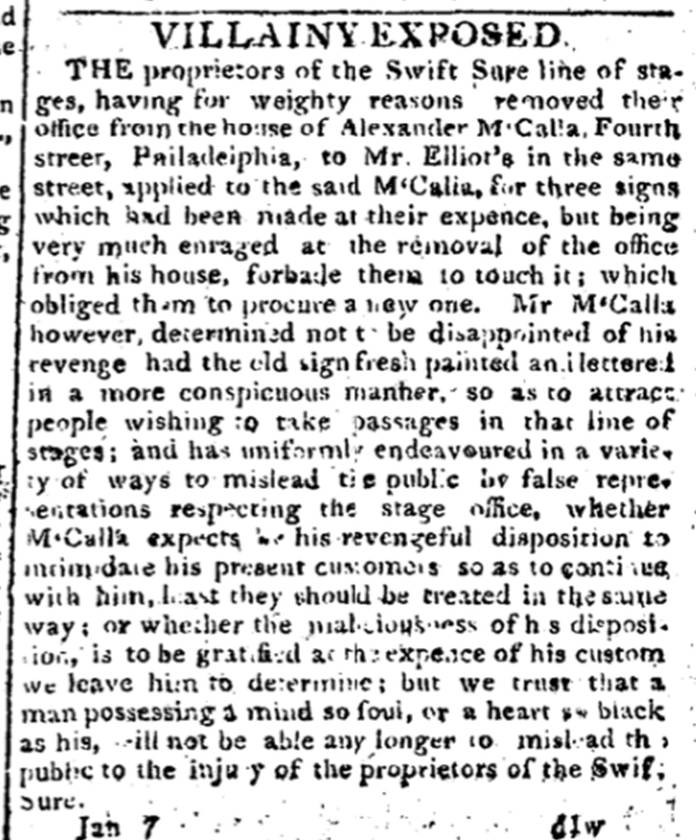
Newspaper article titled “Villainy Exposed” describing a dispute between stage line proprietors and Alexander McCalla in Philadelphia. It accuses McCalla of repainting and misusing old signage to mislead customers after the business moved, portraying his actions as deceitful and harmful to the public and the company.
Aurora for the Country, January 7, 1805. Source: Early American Newspapers, 1690-1922

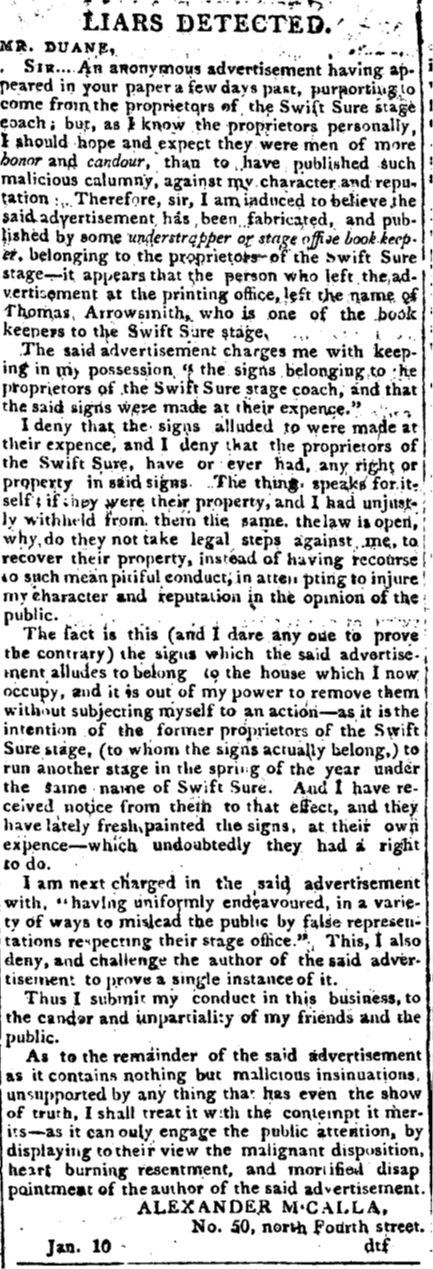
Several days later, on January 10, Mr. McCalla responds to these claims with a rebuttal, entitled, "LIARS DETECTED." Here he names his accuser as "an understrapper" named Thomas Arrowsmith.

McCalla goes on to deny all allegations and further points to Mr. Arrowsmith's "malignant disposition, heart burning resentment, and mortified disappointment."
Image
Newspaper article titled “Liars Detected,” a letter by Alexander McCalla responding to accusations about Swift Sure stage coach signage. He denies wrongdoing, disputes claims of misleading the public, and defends his character, arguing the signs were his property and challenging critics to prove otherwise.
Aurora for the Country, January 10, 1805. Source: Early American Newspapers, 1690-1922

But is this Mr. Arrowsmith a liar?

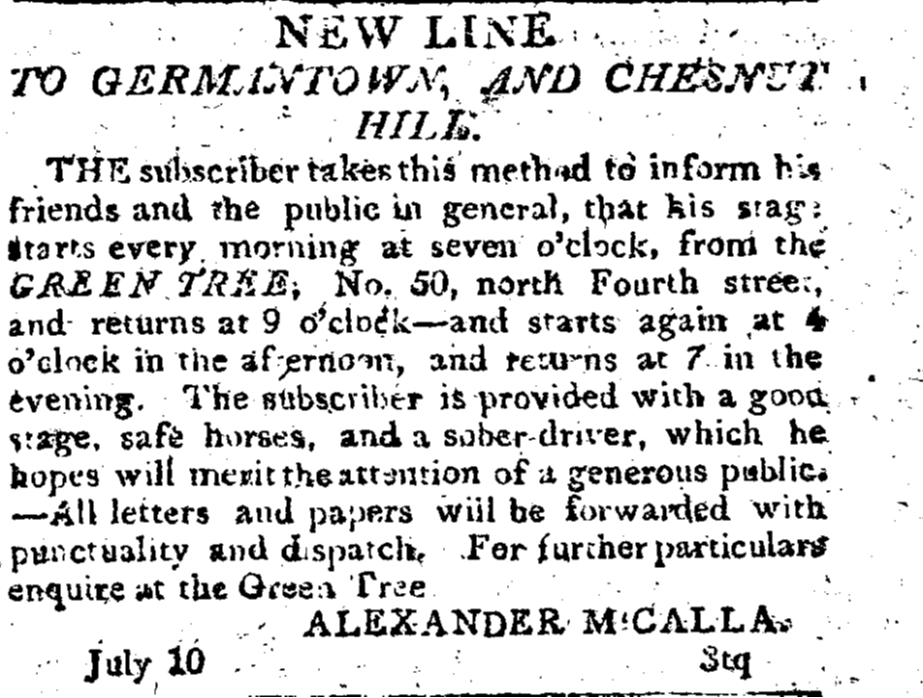
We can see that a year prior, Mr. McCalla was attempting to start his own "good stage, safe horses, and sober driver" service from his inn, in addition to the Swift Sure.
Image
Newspaper advertisement titled “New Line to Germantown and Chestnut Hill” announcing Alexander McCalla’s stagecoach service. It details departure times from the Green Tree on North Fourth Street, return schedules, and emphasizes reliable horses, a sober driver, and punctual delivery of letters and papers.
Aurora for the Country, July 10, 1804. Source: Early American Newspapers, 1690-1922 

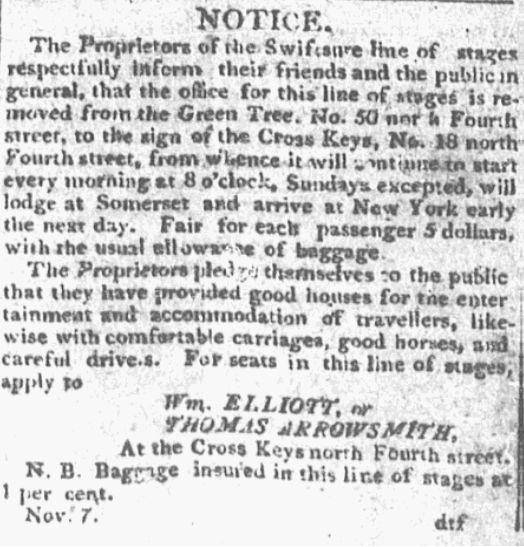
Months later we find the proprietors of the Swift Sure respectfully informing readers that they're relocating from the Green Tree Tavern to a tavern down the street, Mr. Elliot's "sign of the Cross Keys."
Image
Newspaper notice announcing the Swift Sure stage line office relocation from the Green Tree to the Cross Keys on North Fourth Street. It outlines departure times, fares, travel route to New York, accommodations, and services, and lists proprietors William Elliott and Thomas Arrowsmith.
Moving out notice. Aurora General Advertiser, November 8, 1804. Source: Early American Newspapers, 1690-1922

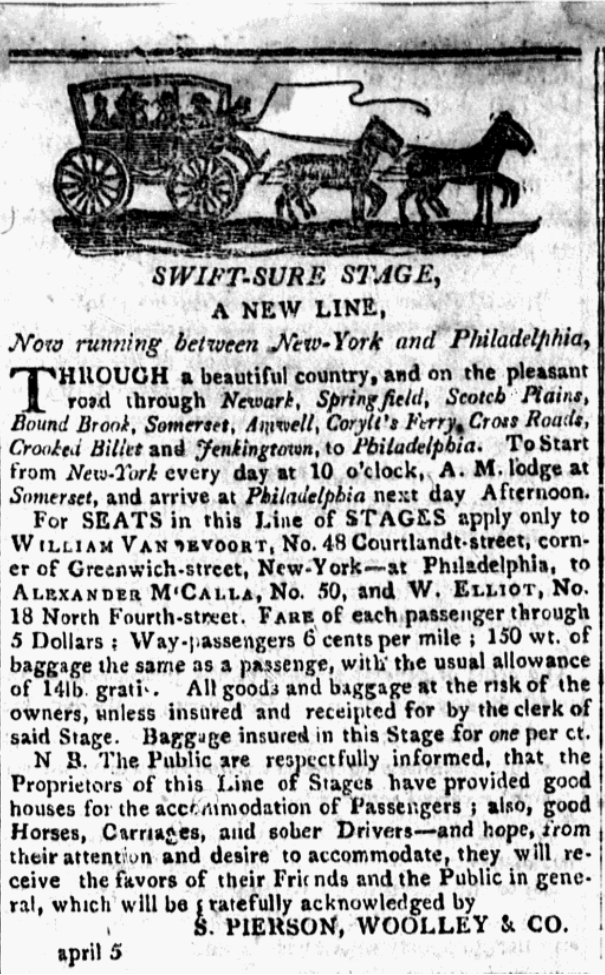
For a time, both taverns became Swift Sure stops—an apparent attempt to appease both sides, despite their proximity. In the New York Commercial Advertiser, April 12, 1805, the stops listed include "Alexander McCalla, No. 50, and W. Elliot No.18, North Fourth-street." 
 

Image
Advertisement titled “Swift-Sure Stage, A New Line” with an illustration of a horse-drawn coach and passengers. The text promotes daily service between New York and Philadelphia, listing route stops, departure times, fares, baggage policies, and booking contacts, while emphasizing comfortable travel, reliable horses, and sober drivers.
New York Commercial Advertiser, April 12, 1805. Source: Early American Newspapers, 1690-1922

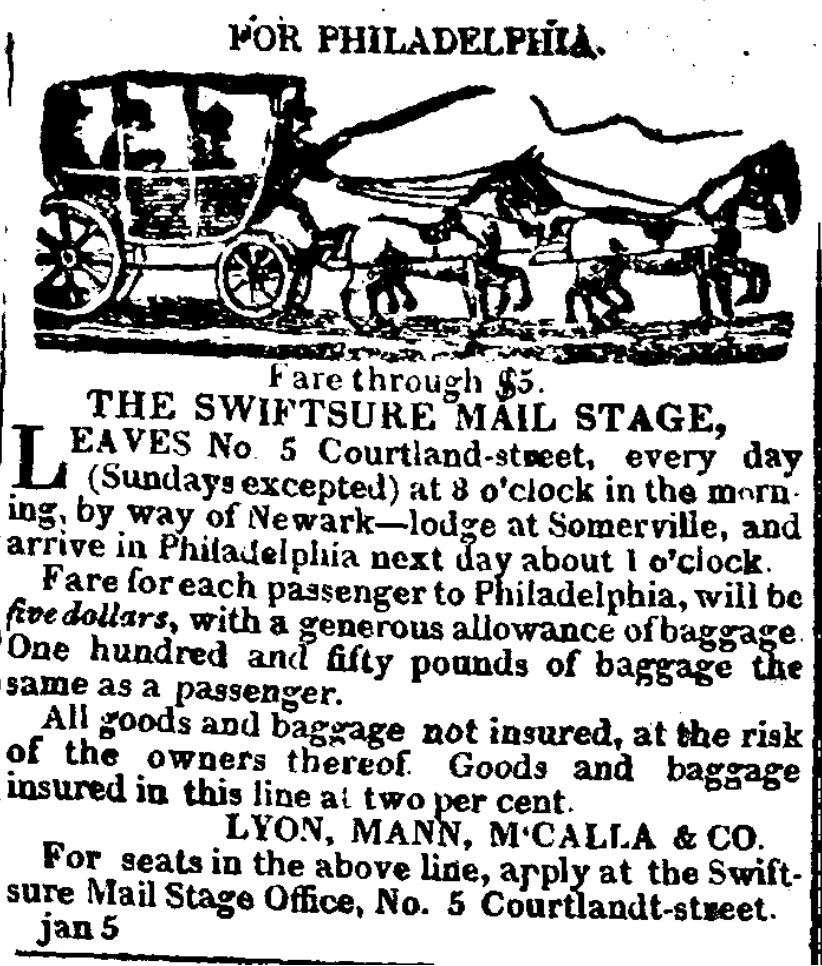
In the end, it appears that Mr. McCalla is the victor. In January 1818, the New York Advertiser lists McCalla as an agent, and the Swift Sure is now known as the "Swiftsure Mail Stage."
Image
Newspaper advertisement for the “Swift-Sure Stage, A New Line,” featuring a small illustration of a horse-drawn coach with passengers. The text promotes daily travel between New York and Philadelphia, listing routes through towns in New Jersey, departure times, fares, baggage terms, and booking agents, while emphasizing comfort, reliable horses, and careful drivers.
New York Advertiser, January 6, 1818. Source: Early American Newspapers, 1690-1922

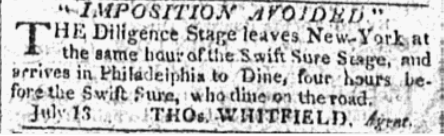
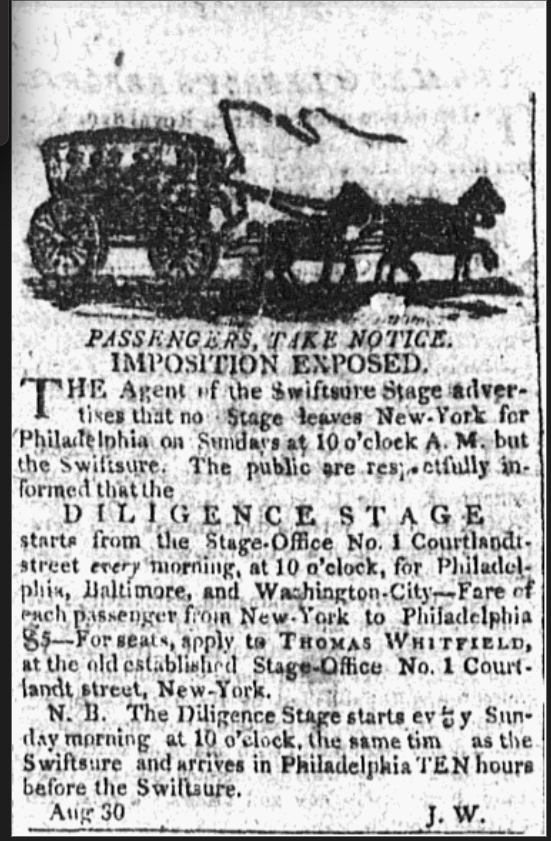
It wasn't only innkeepers who were battling for stagecoach dominance. The stagecoach lines themselves faced stiff competition with one another. Here we see the Diligence Stage claiming to arrive in Philadelphia "four hours before the Swift Sure," and another advertisement claiming to arrive "TEN hours before the Swiftsure."
Image
Newspaper notice titled “Imposition Avoided” comparing the Diligence Stage and Swift Sure stage services between New York and Philadelphia, noting departure times and that the Diligence arrives earlier, allowing passengers time to dine.
New York Evening Post, October 28, 1808. Source: Early American Newspapers, 1690-1922
Image
Newspaper advertisement with a small illustration of a horse-drawn coach. Headlined “Passengers, Take Notice. Imposition Exposed,” it criticizes the Swiftsure Stage and promotes the Diligence Stage, detailing departure times, routes from New York to Philadelphia and beyond, fares, and claiming faster travel, including Sunday service arriving ten hours earlier.
New York Evening Post, October 28, 1808. Source: Early American Newspapers, 1690-1922

Of course, the Swift Sure did not let these claims—made "in the most villainous and infamous manner"—go unanswered.

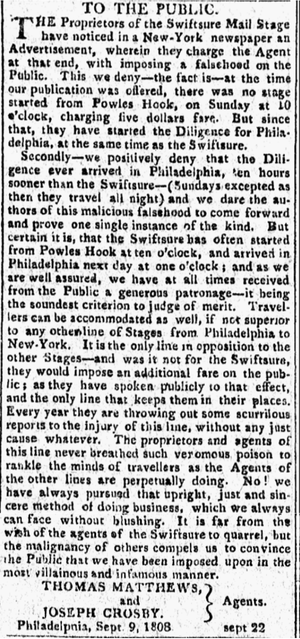
In an advertisement "TO THE PUBLIC," they dismissed the statement as a "malicious falsehood," insisting they had never "breathed such venomous poison to rankle the minds of travellers" as rival agents allegedly did.

As Mr. McCalla capitalized on the Philadelphia Swift Sure success, Swift Sure had clearly become the standard to beat among stage lines.
Image
Newspaper notice titled “To the Public” in which stage line proprietors defend their mail stage service against accusations from a rival. The text disputes claims about departure times and travel speed between New York and Philadelphia, criticizes misleading advertisements, and asserts their reliability and integrity in serving passengers.
New York Commercial Advertiser, October 28, 1808. Source: Early American Newspapers, 1690-1922

Original Swift Sure advertisement from Claypoole's American Daily Advertiser (1799).

Image
Long newspaper advertisement for the “Swift-Sure” stage line featuring a small illustration of a horse-drawn coach. The text promotes a new route between New York and Philadelphia with stops in multiple towns, detailing schedules, fares, baggage policies, and passenger accommodations. It emphasizes safety, reliability, and courteous service, and includes statements from agents defending the line’s reputation against competitors.
Claypoole's American Daily Advertiser (1799). Source: Early American Newspapers, 1690-1922

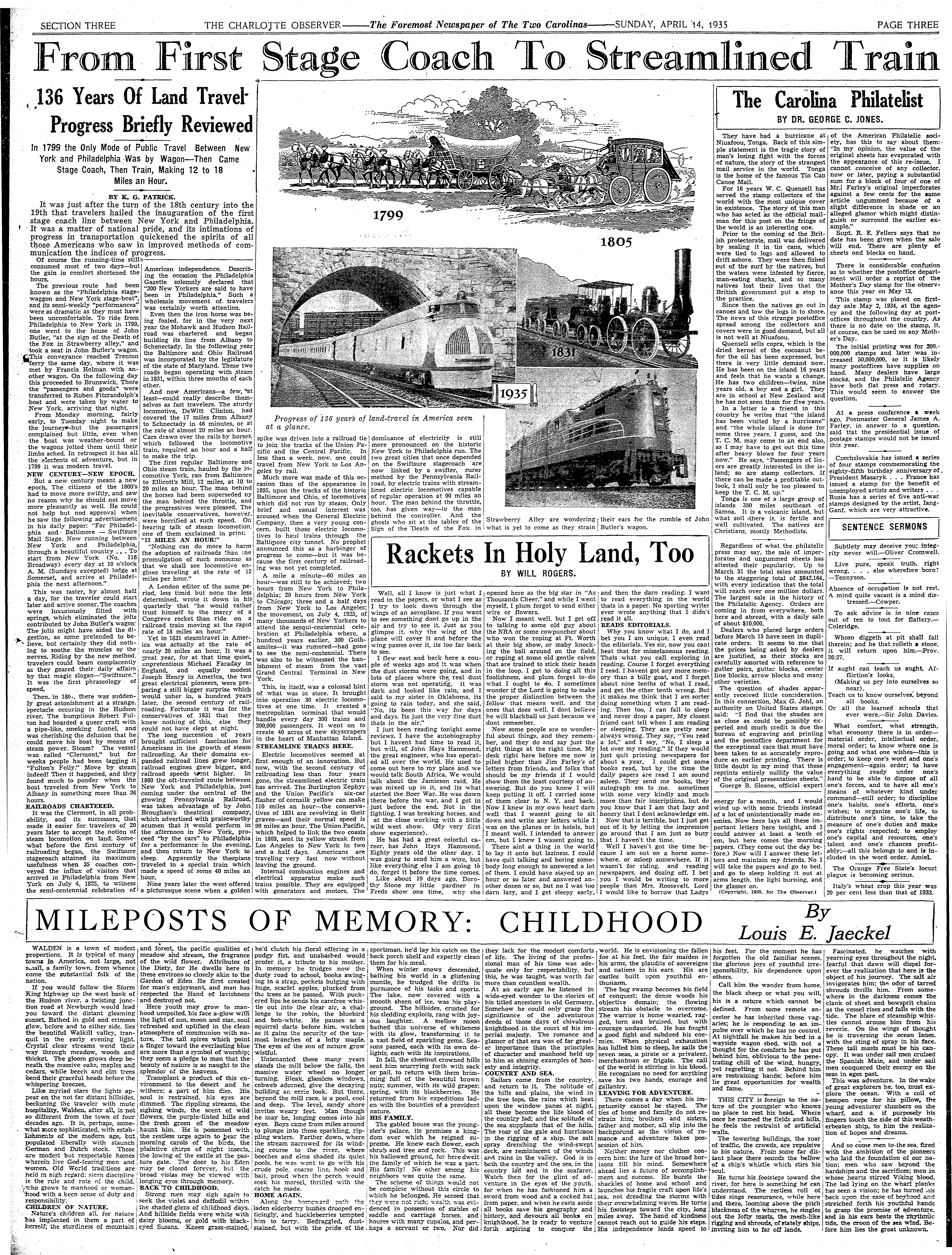
A 1935 Charlotte Observer article about the evolution of public transport specifically talks about Swift Sure.
Image
Full newspaper page from The Charlotte Observer (April 14, 1935) titled “From First Stage Coach to Streamlined Train.” It reviews 136 years of land travel progress, with illustrations of stagecoaches, early locomotives, and a modern streamlined train, alongside columns of text and related articles.
Charlotte Observer, April 14, 1935. Source: Early American Newspapers, 1690-1922

From descriptive 18th-century advertisements to stories of fierce competition to historical reflections from the automobile age, primary sources chronicle the political, social, and cultural forces that shaped the nation. Discover more at Early American Newspapers, 1690-1922

Stay in Touch

Receive Readex news, invitations, and special offers

Sign Up

By clicking "Sign Up", you acknowledge that you have read and understand our Privacy Policy and Terms of Use.