
Reflecting upon the influence of the blue color of the sky: Seeing the world through General A.J. Pleasonton's blue-tinted glasses
In 1871, General A.J. Pleasonton presented ten years' worth of experimental findings to the Philadelphia Society for Promoting Agriculture in an effort to "shed light" on a new subject. Standing before them, Pleasonton—a retired Civil War officer whose experience in horticulture and science was limited to mere interest—read aloud his self-published pamphlet, On the Influence of the Blue Color of the Sky in developing Animal and Vegetable Life.
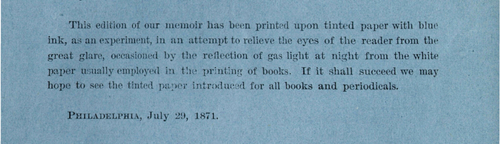
The pamphlet was printed on blue paper with blue ink as a nod to the study and as an experiment in its own right to "attempt to relieve the eyes of the reader from the great glare, occasioned by the reflection of gas light at night from the white paper usually employed in the printing of books."
Expecting criticism from the board but prepared to stand behind his work, Pleasonton had just introduced what became a new wave of pseudoscientific thought.
Many consider Pleasonton's monograph the first major work in contemporary chromotherapy, an idea that certain diseases or ailments can be treated through exposure to specific colors. Inspired by the color of the sky, Pleasonton set out to explore how blue wavelengths may influence the growth of plants and livestock.
His studies center on the interdependent effects of sky color on living organisms. Pleasonton developed this hypothesis by exploring how the sky's color and intensity change throughout the seasons. The book's preface notes:
...his observations have led him to entertain relative to the variations of temperature, and changes of our seasons, which are in harmony with the subjects treated by him in this work.
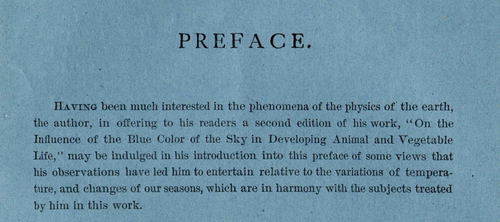
Pleasonton thought the seasonal changes in the sun and sky color determine which plants thrive in warmer months.
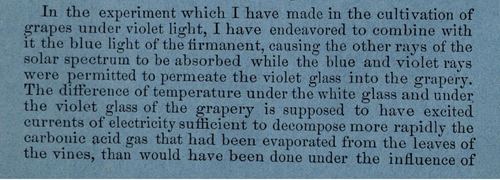
To conduct his experiments, Pleasonton grew grapes in a greenhouse environment. He explains:
In the experiment which I have made in the cultivation of grapes under violet light, I have endeavored to combine with it the blue light of the firmament, causing the other rays of the solar spectrum to be absorbed while the blue and violet rays were permitted to permeate the violet glass into the grapery.
The results of his experiments attempt to "utilize the blue color" to mimic growth under the sun.
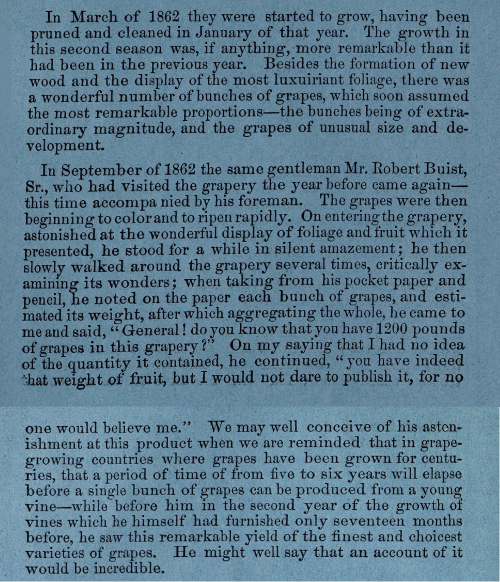
Robert Buist Sr., a noted seedman and horticulturalist from whom Pleasonton procured the vines for his grapes, deemed Pleasonton's findings remarkable. The grapes under the blue glass were growing at outstanding proportions, "the bunches being of extraordinary magnitude, and the grapes of unusual size and development."
Upon seeing the grapes, Pleasonton quotes Buist as saying, "General! Do you know that you have 1200 pounds of grapes in this grapery?... I would not dare to publish it, for no one would believe me."
These findings led Pleasonton and Buist to proclaim the experiment was nothing short of a success.
After grapes, Pleasonton moved on to test the effects of blue light on livestock. He used pigs, raising half under violet light and half under natural sunlight. The two-month-old pigs came from the same litter and were raised identically in diet, schedule, and care, differing only in light exposure. After six months of observation, Pleasonton found that the pigs under the violet light gained more weight than the pigs raised in natural light.
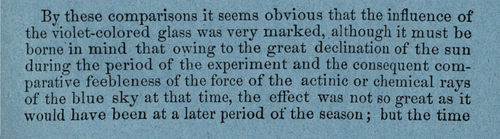
The pamphlet concludes, "By these comparisons it seems obvious that the influence of the violet-colored glass was very marked."
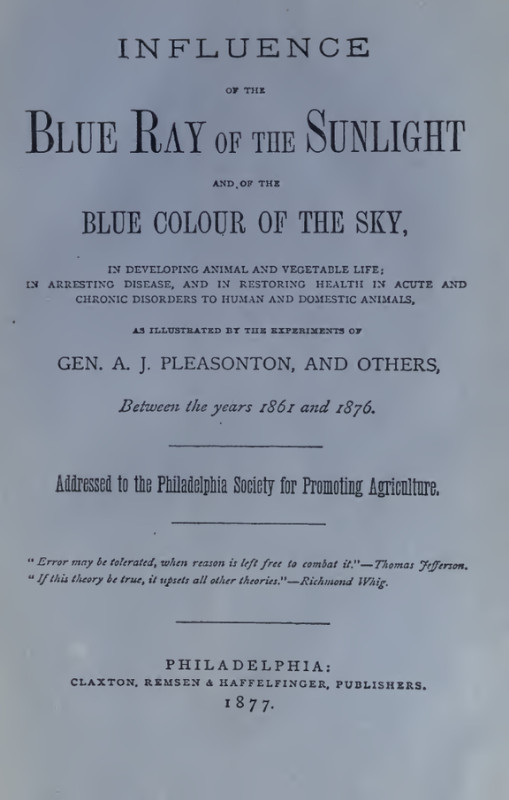
In 1876, Pleasonton expanded his pamphlet into a full book, The Influence of the Blue Ray of the Sunlight and of the Blue Color of the Sky: In developing animal and vegetable life; in arresting disease, and in restoring health in acute and chronic disorders to human and domestic animals. The book built on his experiments and expanded his theories. His new studies found that plants and animals flourished when sunlight was filtered through blue glass, leading him to conclude that blue light could ward off disease. He even patented a greenhouse with specialized blue-filtered glass.
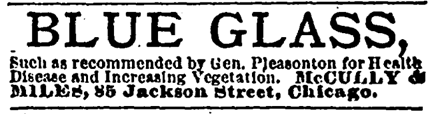
While some horticulturalists and scientists consider the study of chromotherapy a load of quackery, Pleasonton had many loyal followers who supported his ‘scientific' findings. A public fascination with blue glass found its way into the popular press across the country. People began wearing blue eyeglasses to "ward off disease" as newspapers ran advertisements for blue glass in all forms.
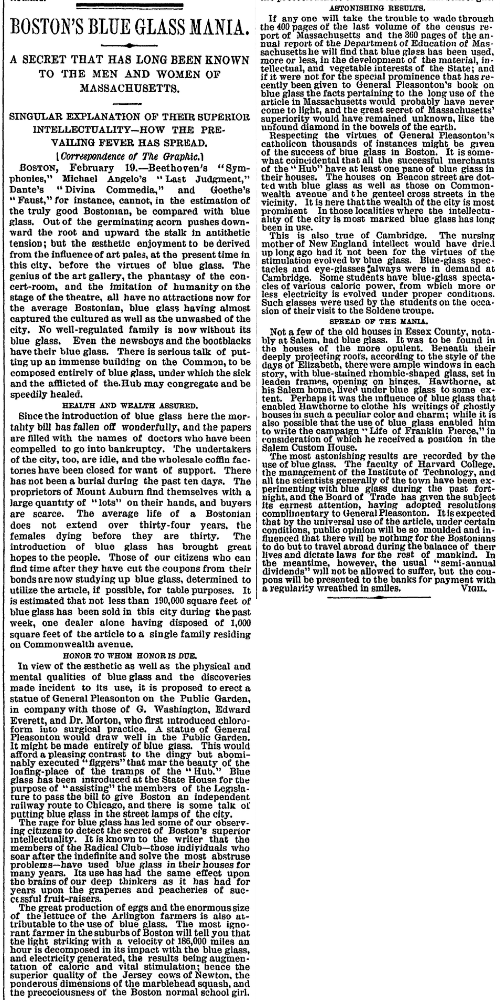
In 1877, a blue glass craze fully erupted in Boston. Massachusetts residents had observed the effects of blue glass for several years before Pleasonton's discovery. The Massachusetts census and the Department of Education's annual report praised blue glass for its aesthetic qualities as well as its mental and physical benefits. The people of Boston praised Pleasonton's work as it finally acknowledged the ‘true' advantageous properties of blue glass.
An article in the Daily Graphic proposed that the city erect a statue of General A.J. Pleasonton in the Public Garden among the figures of George Washington, Edward Everett, and Dr. Morton. The journalist suggested making the statue completely out of blue glass to truly honor his innovation.
Speaking on behalf of all Boston citizens, the writer notes, "Public opinion will be so moulded and influenced that there will be nothing for the Bostonians to do but travel abroad during the balance of their lives and dictate laws for the rest of mankind."
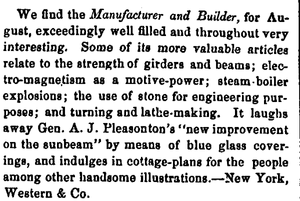
Even as Harvard faculty began conducting experiments inspired by Pleasonton's apparent success, many journalists and scientists did not take his "improvement on the sunbeam" seriously.
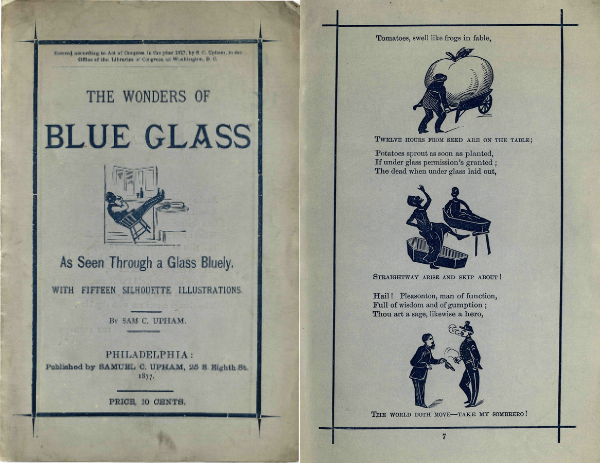
Samuel Curtis Upham, known as "Honest Sam," felt strongly about the validity of the claims. Upham, a jack of all trades best known for his work in counterfeit bills, wrote hymns and other poems in his free time.
In 1877, he wrote and published The wonders of blue glass as seen through a glass bluely, with fifteen silhouette illustrations in response to Pleasonton's book. The satirical poem reads "Hail! Pleasonton, man of function, Full of wisdom and of gumption; Thou art a sage, likewise a hero."
Pleasonton's first pamphlet paved the way for a newfound interest in color theory and chromotherapy. While some praised his findings and the use of blue glass, some scientists and horticulturalists remained skeptical. Regardless, the blue glass craze spoke for itself when it came to how infectious the idea was.
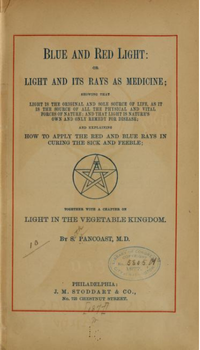
Seth Pancoast, an American homeopathic physician, explored the therapeutic benefits of chromotherapy for himself. Even then, his book, Blue and Red Light; or, Light and Its Rays as Medicine (1877), was a mix of skepticism and support for Pleasonton's findings. However, even limited endorsement from physicians appeared to lend legitimacy to the blue-glass phenomenon.
Whether a scientific breakthrough or not, Pleasonton's work illustrates how the exploration of an unconventional idea can lead to a new perspective, sometimes through blue-tinted glasses.
Put on your blue-tinted glasses and visit Readex's product pages to learn more about American Pamphlets, Series 1, 1820-1922 and Early American Newspapers, 1690-1922.