
"...the chief exponent of the scientific thought of the people of the United States...": How to Research the History of the Smithsonian Institution
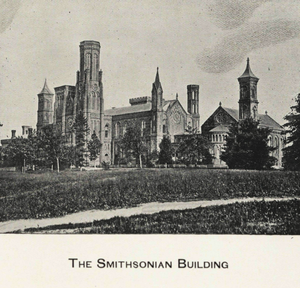
The Smithsonian Institution and its twenty museums and galleries have been in the news recently. There is controversy. If you would like to know more, we encourage you to do your own research and urge you to start with the institution's history. We suggest two possible, and complementary, approaches.
Subscribers to Early American Imprints can conduct an Advanced Search by entering Smithsonian in the Citation field, which yields 45 results, sorted oldest to newest. Results may vary depending on the collections your institution offers.
The 43rd result, "An account of the Smithsonian Institution its origin, history, objects and achievements [by G. Brown Goode]" provides a useful guide to the founding and early development of the institution. Goode was a scientist and early administrator of the Smithsonian who died in 1896 before completing the history for that year's 50th anniversary celebration. Samuel Pierpont Langley, who succeeded Goode, finished it.

The 12th result in our search, "The Smithsonian Institution an article from the North American Review, October, 1854." The author provides a somewhat jaundiced review of the same topic as Goode. Aspects of his argument include arcane information, but he merits attention.
Before moving on to our second possibility, pause a moment to peruse "Vocabulary of the jargon or trade language of Oregon." [number 11 in our results] Examples:

Or click on "Catalogue of the Berlandier manuscripts deposited in the Smithsonian Institution, Washington, D.C." [number 9 in our results]
Jean-Louis Berlandier was a French Mexican scientist who concentrated on biology and botany. His catalogue is one of thousands collected by the Smithsonian.

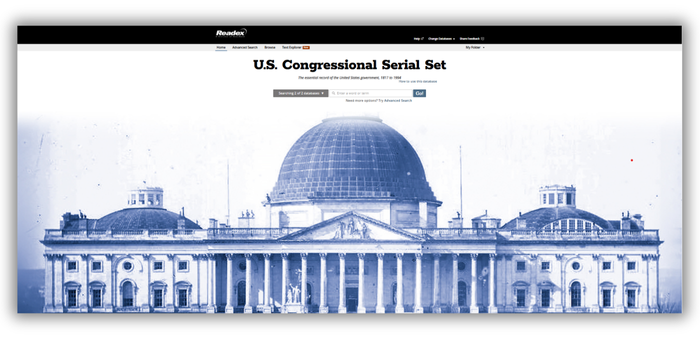
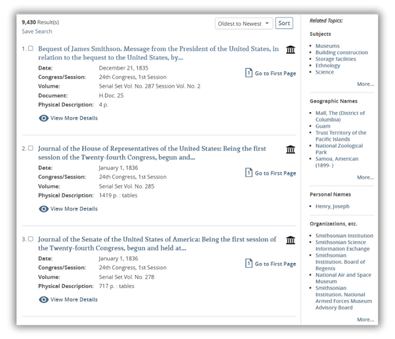
Our second approach is to conduct a search in the Readex U.S. Congressional Serial Set, 1817-1994. A simple search on the term Smithsonian yields almost 9,500 results.
Researchers can navigate to Related Topics and other tools for narrowing their searches.
Look for the institution's annual reports. The first few are relatively concise, but they soon became expansive, often running to more than 1,000 pages including illustrations, maps, and photographs. Table of Contents and indices began to appear. Time spent exploring these extraordinary documents promises the researcher the joy of discovery.
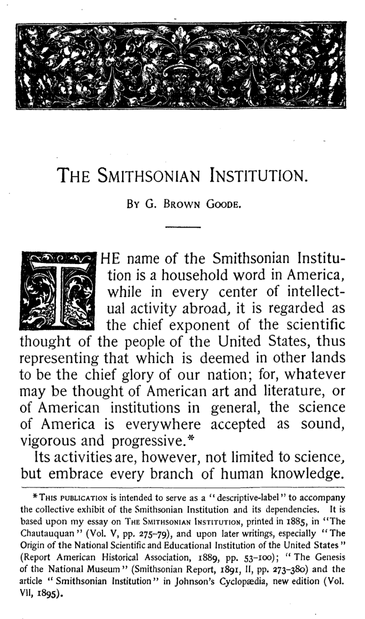
To conclude we return to Goode's history and quote his first two paragraphs:
The name of the Smithsonian Institution is a household word in America, while in every center of intellectual activity abroad, it is regarded as the chief exponent of the scientific thought of the people of the United States, thus representing that which is deemed in other lands to be the chief glory of our nation; for, whatever may be thought of American art and literature, or of American institutions in general, the science of America is everywhere accepted as sound, vigorous and progressive.
Its activities are, however, not limited to science, but embrace every branch of human knowledge.