
"Rebels! Turn out your Dead!": The Prison Ship Martyrs of the American Revolution
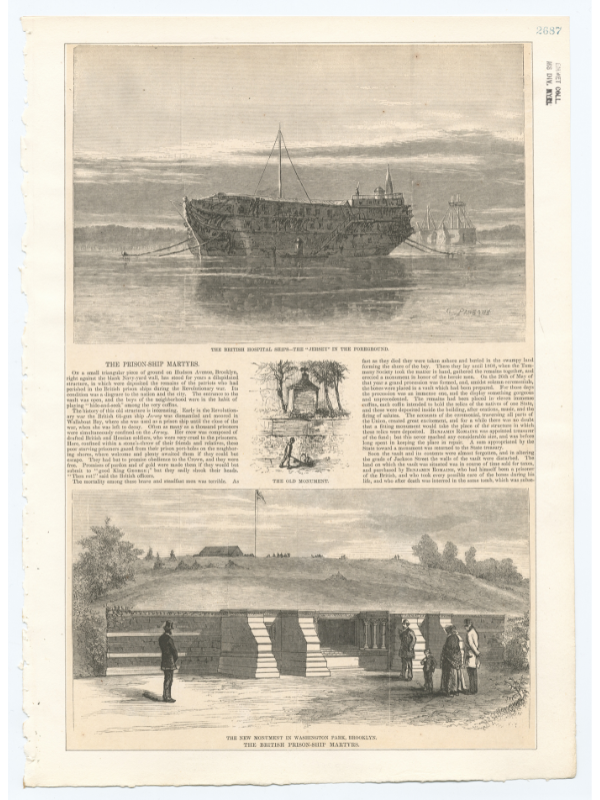
The modern rush of life in Brooklyn's historic Wallabout neighborhood is a stark contrast to the brutal history beneath the pavement. Just a stone's throw away is Wallabout Bay where, in the winter of 1779, the former hospital ship, HMS Jersey, was converted into a prison ship. This vessel would later become known as "Hell" by all who entered.
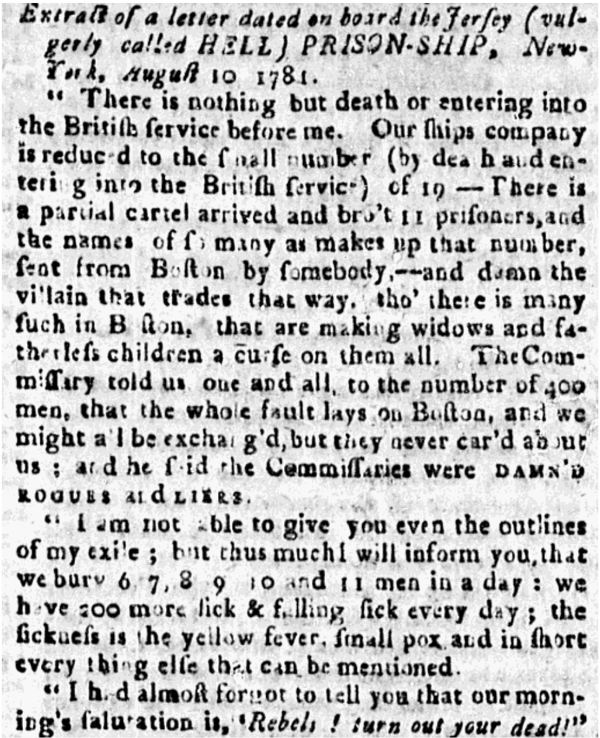
In an extract of a letter dated 1781, an unnamed prisoner aboard the ship wrote,
I am not able to give you even the outlines of my exile; but thus much I will inform you, that we bury 6, 7, 8, 9, 10 and 11 prisoners a day: we have 200 more sick & falling sick every day; the sickness is the yellow fever, small pox, and in short every thing else that can be mentioned.
I had almost forgot to tell you that our morning's salutation is, 'Rebels! Turn out your dead!'
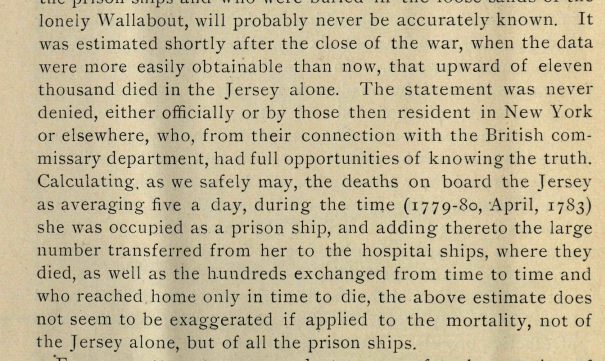
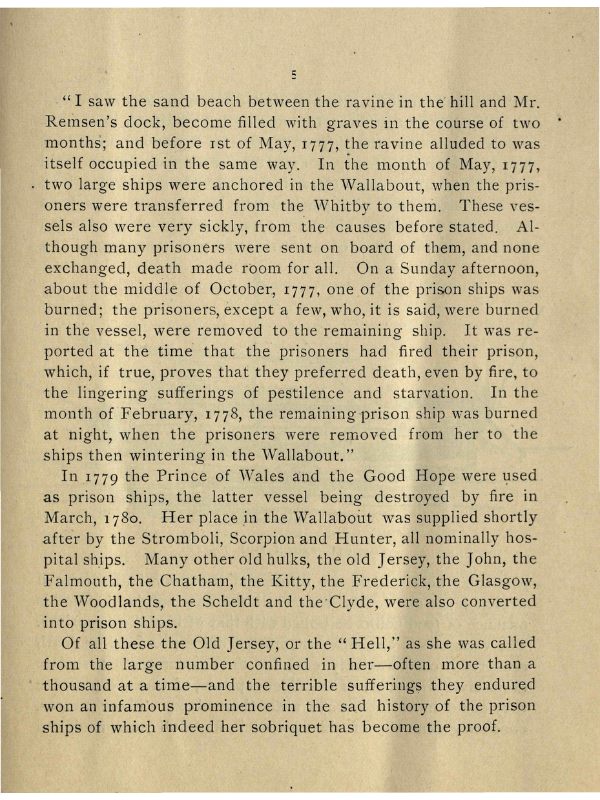
A total of 16 prison ships floated in the Bay. By the time the Jersey was decommissioned in 1783, abandoned, and burned, it's estimated more than 11,000 prisoners had died due to sickness and starvation. This brutal system began as a result of early critical losses by the rebel troops in New York.
Washington's defeat in the August 27, 1776 Battle of Long Island, (or Brooklyn) resulted in the loss of the strategically important Port of New York. At the time, prisoners (both rebel soldiers and citizens accused of supporting them) were held in local facilities like hospitals, churches, Columbia College, and the city's large sugar houses. All were quickly overrun. Prisoners were forced to stand, diseases spread quickly, and rations were scarce.
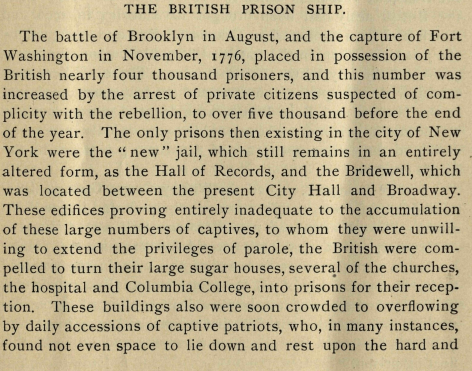
To make more room, hulked, decommissioned, and captured ships were converted to floating prisons.
The Jersey was described in a Senate report as "...originally a 60-gun ship...[it] was converted into a prison ship. She was dismantled, her portholes were closed and securely fastened, and their places supplied by two tiers of small holes, each about 20 inches in diameter, with two iron bars crossed at right angles."
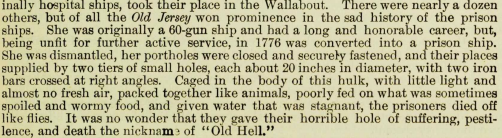
Prison ship survivors painted a gruesome picture of bravery, torture, and survival. During the day, guards allowed some prisoners deck time in shifts, but by nightfall everyone was forced below deck.
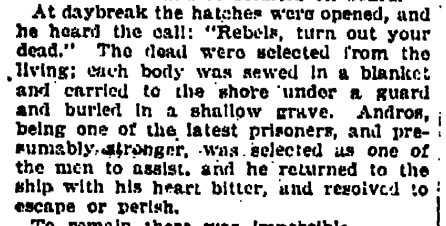
At daybreak the hatches were opened [...] The dead were selected from the living; each body was sewed in a blanket and carried to the shore under a guard and buried in a shallow grave.
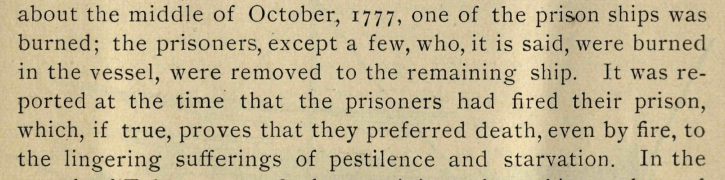
Conditions upon these ships were so bad that, in one account, the prisoners themselves set one ship on fire, choosing to be burned alive, over continued internment.
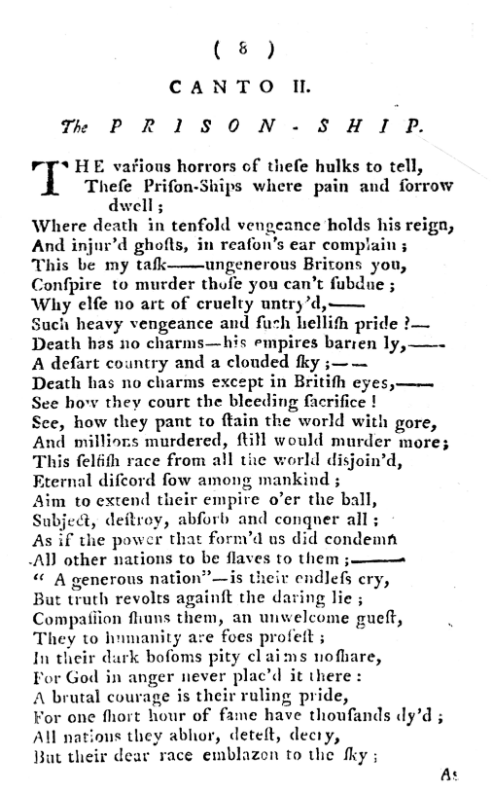
The desperation was so profound that it was further immortalized in the poem "The British prison-ship: a poem, in four cantoes" by Philip Freneau in 1781.
The various horrors of these hulks to tell,
These prison-ships where pain and sorrow
dwell;
Where death in tenfold vengeance holds his reign,
And injur'd ghosts, in reason's ear complain.
This be my talk – ungenerous Britons you,
Conspire to murder those you can't subdue;
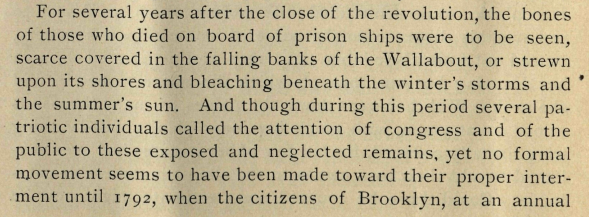
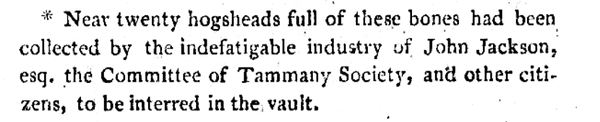
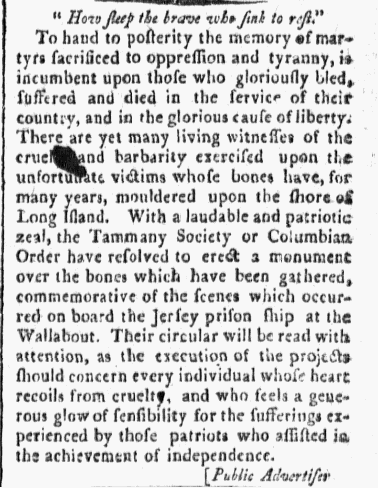
For more than century, shocked residents discovered bones along the shoreline. The first talks about a proper burial and monument began in 1792, less than a decade after the end of the Revolutionary War. At that time, John Jackson, a new property owner, discovered bones strewn on his property along the bay.
Jackson then turned to the Tammany Society, and other citizens, to collect nearly 20 "hogsheads" or barrels full of bones for internment.
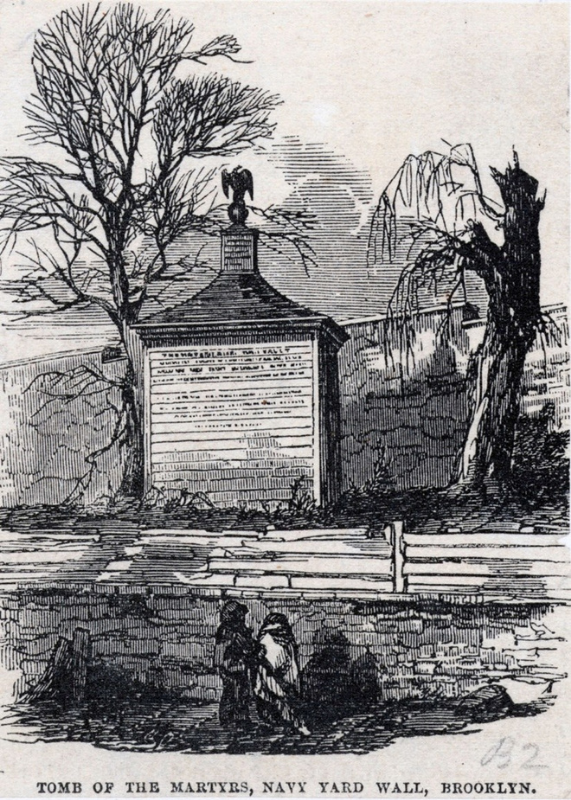
In 1803, a sepulcher was set to be erected on Jackson's property for the remains. However, five years passed without action. In 1808, a cornerstone was laid and later a brick building with an eagle mounted on the roof was constructed above the vaults.
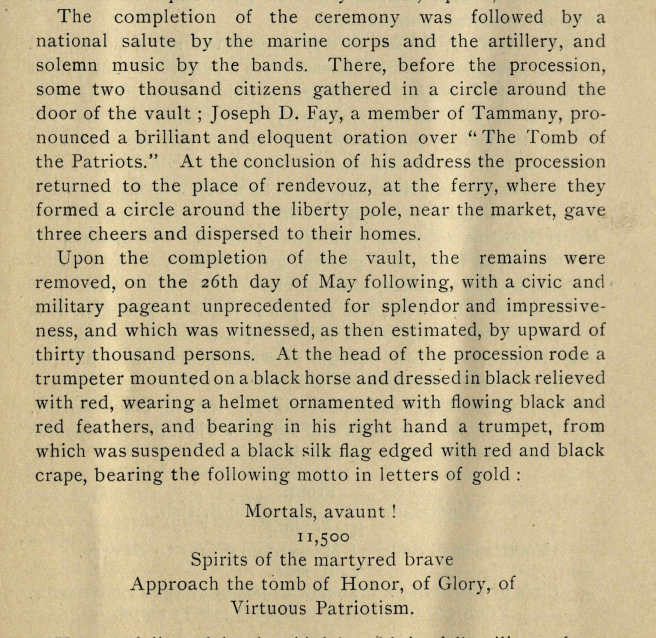
A ceremony followed the event, in which the marine corps and the artillery fired a national salute, and bands played solemn music. In total two thousand citizens gathered for the occasion.
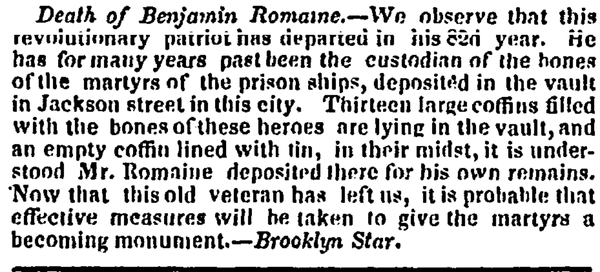
Little was done to maintain the property, however, and it quickly fell into disrepair. In 1839, Benjamin Romaine, a prison ship survivor, purchased the property and renewed talks about constructing a proper monument, petitioning support from the government but ultimately failed. Upon his death in 1844 he was interred with his fellow soldiers in the existing crypt .
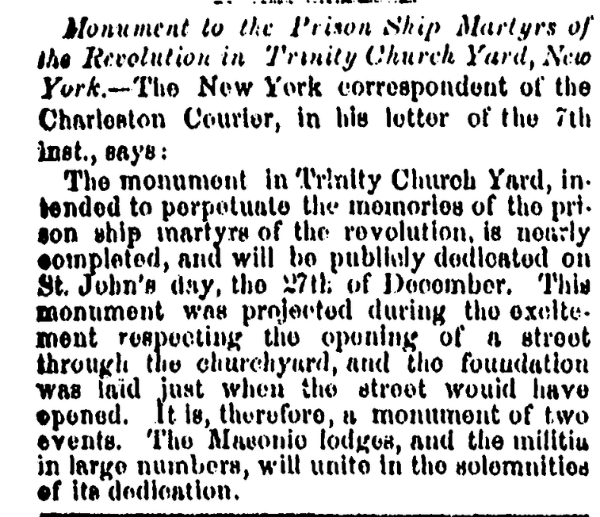
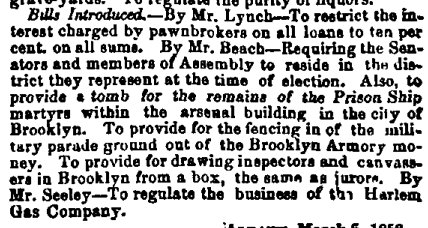
Several more attempts were made in the 1850s. One offered to move the remains to a monument in Trinity Church Yard and another a tomb within the arsenal building of the Brooklyn Naval Yard.
It wasn't until 1873 that a new brick mausoleum was constructed in Fort Greene Park, where the remains were moved and resided for over 20 years.
In January 1900, additional bones were discovered during the construction of a building at the Navy Yard renewing interest. The following year, a committee was appointed to replace the current tomb.
Finally, in 1908, a new memorial was dedicated with a ceremony and a parade that included President-elect William Howard Taft and governors from New Jersey, New York, and Delaware.
However, the site fell into disrepair and was vandalized resulting in multiple restorations.
In 2004, New York City dedicated $3.5 million to its restoration. Plagued by electrical and budgetary issues, the restoration ultimately cost $5.1 million.
In 2013, U.S. Congressman Hakeem Jeffries introduced the Prison Ship Martyr's Monument Preservation Act, to study the suitability and feasibility of adding the monument to the National Parks System stating, "As one of America's largest revolutionary war burial sites and in tribute to the patriots that lost their lives fighting for our nation's independence, this monument deserves to be considered as a unit of the National Park Service." The act was passed in 2014. The study was completed but further evaluation is ongoing.
If these bones could talk, they would tell the story of sacrifice and a promise by many to keep their words alive. You can explore these stories, and others, in Readex's collection of early American imprints, newspapers, and government documents.