
A Building Twice-struck by Lightning OR, Dictatorship Despoiled! George Washington Consecrates the “Temple of Virtue” with his 1783 Newburgh Address
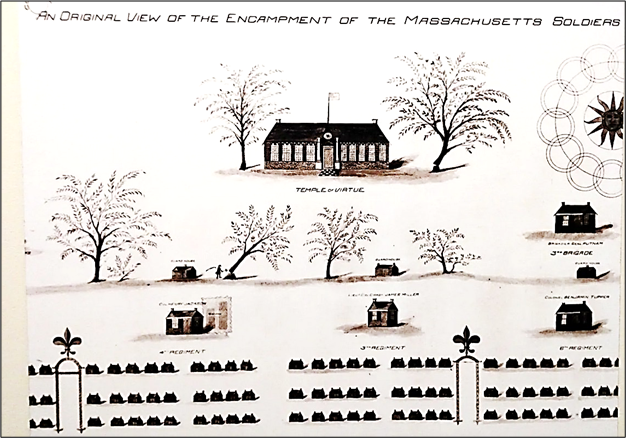
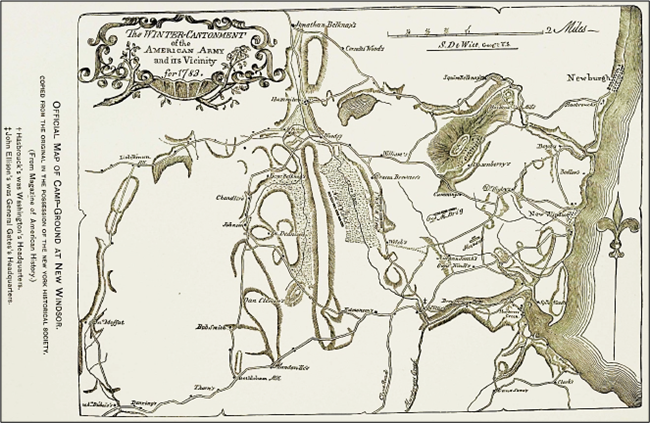
What is the "Temple of Virtue," anyway? Something lost to Ancient Greece or Rome? Superman's second home when he isn't hanging out in the Fortress of Solitude? How about a Colonial-era structure intended for religious services near the Hudson River in New Windsor, New York, just south of Newburgh? Of course it's the latter, shown at the top of the sketch above. It hosted George Washington and Continental Army officers in 1783 while they were waiting for the British Army to clear out of New York City after the surrender of Cornwallis at Yorktown.
The original building was said to have been struck by lightning in June 1783, a few months after Washington delivered his famous Newburgh Address in it. The site was sold and the building dismantled when the Continental Army disbanded—and thanks largely to that speech, the army did disband—but it was a near thing. The Temple building was replaced in the 1960s by a loose interpretation of the original, of which the sketch above is the only known view.
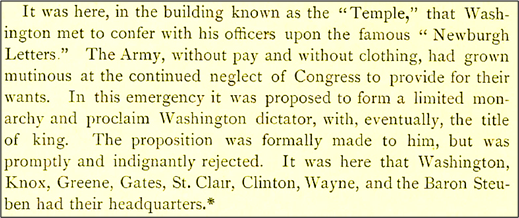
It was here, in the building known as the Temple, that Washington met to confer with his officers upon the famous 'Newburgh Letters.' The Army, without pay and without clothing, had grown mutinous at the continued neglect of Congress to provide for their wants. In this emergency it was proposed to form a limited monarchy and proclaim Washington dictator, with, eventually, the title of king. The proposition was formally made to him, but was promptly and indignantly rejected. It was here that Washington, Knox, Greene, Gates, St. Clair, Clinton, Wayne., and the Baron Steuben had their headquarters.
A few words stand out in the above: Monarchy. Dictator. King. As at Valley Forge, Pennsylvania in 1777, once again the Continental Army was without pay and clothing. But now they were in a position to do something about it. Once again, Congress was the problem; it had the authority to spend money but not to raise it in the form of taxes. That power was delegated to the states. Dictators and kings, however, have the power to raise both money and hell when they're backed up by military force. They can make offers that can't be refused. So, a solution to this whole non-payment of soldiers problem was near at hand: Lock. Load. Fix bayonets. Over 7,000 armed, trained men. No waiting. That was the gist of various letters that circulated among the troops in 1783.
The first tremors of this earthquake fittingly originated in Pennsylvania, in 1781. Then they spread to New Jersey. This is a big block of text but bear with it as the stakes were high and people were shot for making just demands.
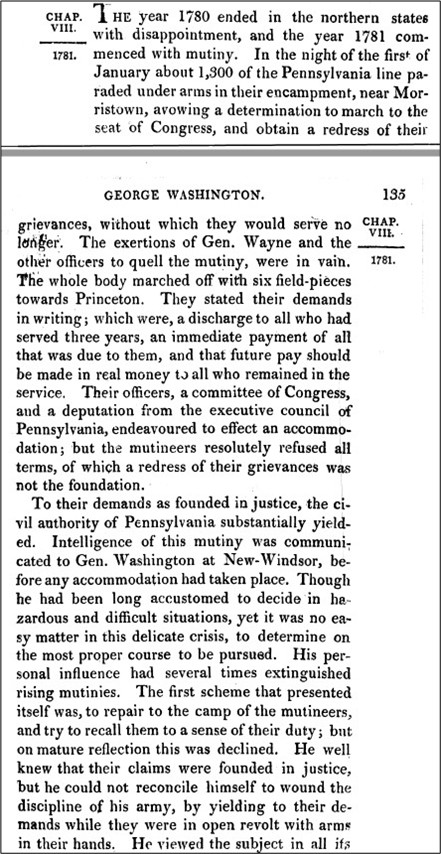
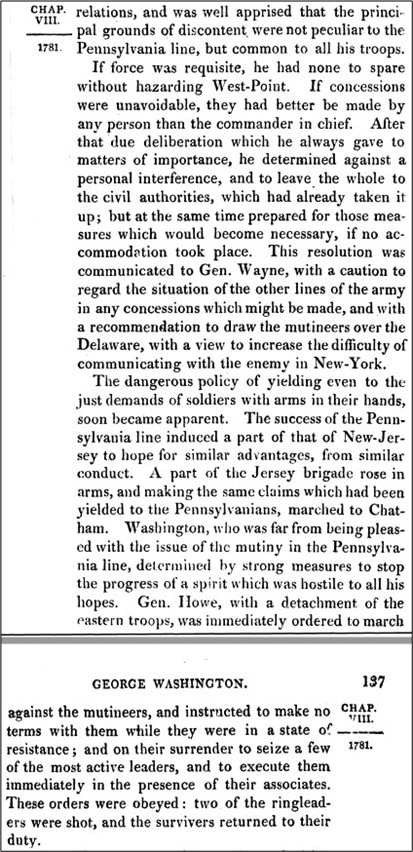
The year 1780 ended in the northern states with disappointment, and the year 1781 commenced with mutiny. In the night of the first of January, about 1,300 of the Pennsylvania line paraded under arms in their encampment, near Morristown, avowing a determination to march to the seat of Congress, and obtain a redress of their grievances, without which they would serve no longer. The exertions of Gen. Wayne and the other officers to quell the mutiny, were in vain. The whole body marched off with six field pieces towards Princeton. They stated their demands in writing; which were, a discharge to all who had served three years, an immediate payment of all that was due to them, and that future pay should be made in real money to all who remained in the service. Their officers, a committee of Congress, and a deputation from the executive council of Pennsylvania, endeavored to effect an accommodation; but the mutineers resolutely refused all terms, of which a redress of their grievances was not the foundation.
To their demands, as founded in justice, the civil authority of Pennsylvania substantially yielded. Intelligence of this mutiny was communicated to General Washington at New-Windsor, before any accommodation had taken place. Though he had been long accustomed to decide in hazardous and difficult situations, yet it was no easy matter in this delicate crisis, to determine on the most proper course to be pursued. His personal influence had several times extinguished rising mutinies. The first scheme that presented itself was, to repair to the camp of the mutineers, and try to recall them to a sense of their duty, but on mature reflection this was declined. He well knew that their claims were founded in justice, but he could not reconcile himself to wound the discipline of his army, by yielding to their demands while they were in open revolt with arms in their hands. He viewed the subject in all its relations, and was well apprised that the principal grounds of discontent were not peculiar to the Pennsylvania line, but common to all his troops.
If force was requisite, he had none to spare without hazarding West-Point. If concessions were unavoidable, they had better be made by any person than the commander in chief. After that due deliberation which he always gave to matters of importance, he determined against a personal interference, and to leave the whole to the civil authorities, which had already taken it up; but at the same time prepared for those measures which would become necessary, if no accommodation took place. This resolution was communicated to Gen. Wayne, with a caution to regard the situation of the other lines of the army in any concessions which might be made, and with a recommendation to draw the mutineers over the Delaware, with a view to increase the difficulty of communicating with the enemy in New-York.
The dangerous policy of yielding even to the just demands of soldiers with arms in their hands, soon became apparent. The success of the Pennsylvania line induced a part of that of New-Jersey to hope for similar advantages, from similar conduct. A part of the Jersey brigade rose in arms, and making the same claims which had been yielded to the Pennsylvanians, marched to Chatham. Washington, who was far from being pleased with the issue of the mutiny in the Pennsylvania line, determined by strong measures to stop the progress of a spirit which was hostile to all his hopes. Gen. Howe, with a detachment of the eastern troops, was immediately ordered to march against the mutineers, and instructed to make no terms with them while they were in a state of resistance; and on their surrender to seize a few of the most active leaders, and to execute them immediately in the presence of their associates. These orders were obeyed: two of the ringleaders were shot, and the survivors returned to their duty.
So, although state legislatures had money, collecting it proved hazardous despite the justice of the claims and the implied violence of the means at hand. But this problem did not go away. It got bigger.
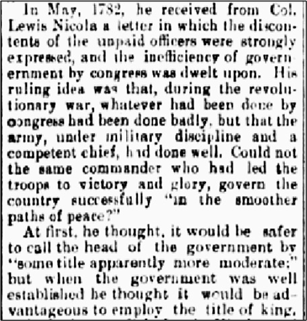
In May, 1782, he [General Washington] received from Col. Lewis Nicola a letter in which the discontents of the unpaid officers were strongly expressed, and the inefficiency of government by congress was dwelt upon. His ruling idea was that, during the revolutionary war, whatever had been done by congress had been done badly, but that the army, under military discipline and a competent chief, had done well. Could not the same commander who had led the troops to victory and glory, govern the country successfully 'in the smoother paths of peace?'
At first, he thought, it would be safer to call the head of government by 'some title apparently more moderate;' but when the government was well established he thought it would be advantageous to employ the title of king.
Here's Washington's reply to Nicola, in full:
Sir—With a mixture of great surprise and astonishment, I have read with attention the sentiments submitted to my perusal. Be assured, sir, no occurrence in the course of the war has given me more painful sensations, than your information of there being such ideas existing in the army, as you have expressed, and I must view with abhorrence and reprehend with severity. For the present the communication of them will rest in my own bosom, unless some further agitation of the matter shall make a disclosure necessary.
I am much at a loss to conceive what part of my conduct could have given encouragement to an address, which to me seems big with the greatest mischiefs that can befall my country. If I am not deceived in the knowledge of myself, you could not have found a person to whom your schemes are more disagreeable.
At the same time, in justice to my own feelings, I must add, that no man possesses a more sincere wish to see ample justice done to the Army than I do—and, as far as my power and influence, in a constitutional way, extend, they shall be employed to the utmost of my abilities to effect it, should there be any occasion. Let me conjure you, then, if you have any regard for your country, concern for yourself or posterity, or respect for me, to banish these thoughts from your mind, and never communicate, as from yourself or anyone else, a sentiment of the like nature.
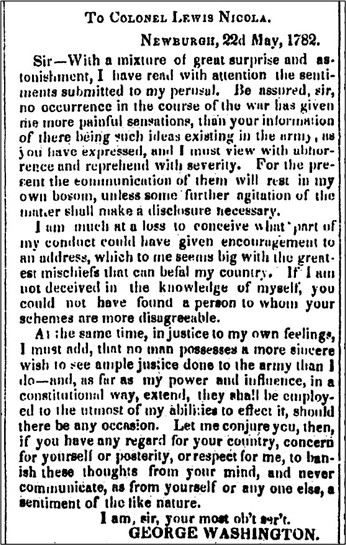
Washington's reply was a pretty hard "No" to Col. Nicola and the advocates of armed intervention to collect justly acquired debts. It did nothing to change Congress's intransigence and neglect of its obligations to its fighting men though.
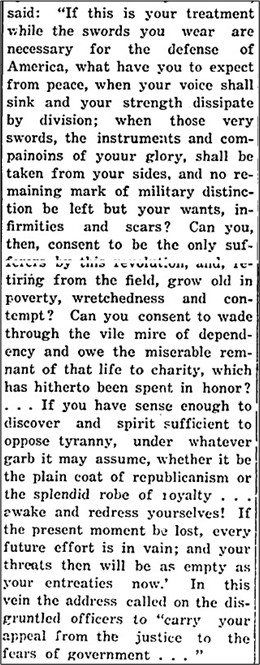
'On March 10, 1783, as word of a preliminary peace with Britain was received, anonymous letters were circulated among the troops calling once more for armed intervention. The letters are attributed to Major John Armstrong, an aide-de-camp of General Horatio Gates. 'If this is your treatment, while the swords you wear are necessary for the defense of America, what have you to expect from peace, when your voice shall sink and your strength dissipate by division; when those very swords, the instruments and companions of your glory, shall be taken from your sides, and no remaining mark of military distinction be left but your wants, infirmities and scars? Can you, then, consent to be the only sufferers by this revolution, and, retiring from the field, grow old in poverty, wretchedness and contempt? Can you consent to wade through the vile mire of dependency, and owe the miserable remnant of that life to charity, which has hitherto been spent in honour? … If you have sense enough to discover and spirit sufficient to oppose tyranny, under whatever garb it may assume, whether it be the plain coat of republicanism or the splendid robe of royalty, … awake and redress yourselves! If the present moment be lost, every future effort is in vain; and your threats then will be as empty as your entreaties now.' In this vein the address called on the disgruntled offices to 'carry your appeal from the justice to the fears of government...'
And it wasn't just the rank-and-file soldiers who were making these demands. The officers, in many cases the peers or even superiors of members of Congress, shared such claims and to an even greater degree as they were promised much more for their service than enlisted men were. Three men especially—Robert Morris, Gouverneur Morris, and Alexander Hamilton—have been associated with the appearance and support of the Newburgh letters as a means of fostering a stronger central government. Hamilton initially favored an elected president who would serve for life rather than be limited to a fixed term—very close to a king.
A meeting was called by the proponents of the insurrection. Washington learned of it and had it postponed to March 15. It was to take place in the "Temple:"
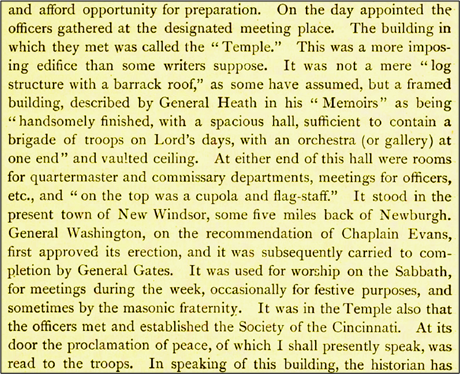
The building in which they met was called the 'Temple.' This was a more imposing edifice than some writers suppose. It was not a mere 'log structure with a barrack roof,' as some have assumed, but a framed building, described by General Heath in his 'Memoirs' as being 'handsomely finished, with a spacious hall, sufficient to contain a brigade of troops on Lord's days, with an orchestra (or gallery) at one end' and vaulted ceiling. At either end of this hall were rooms for quartermaster and commissary departments, meetings for officers, etc., and 'on the top was a cupola and flagstaff.' It stood in the present town of New Windsor, some five miles back of Newburgh. General Washington, on the recommendation of Chaplain Evans, first approved its erection, and it was subsequently carried to completion by General Gates. It was used for worship on the Sabbath, for meetings during the week, occasionally for festive purposes, and sometimes by the masonic fraternity. It was in the Temple also that the officers met and established the Society of the Cincinnati.
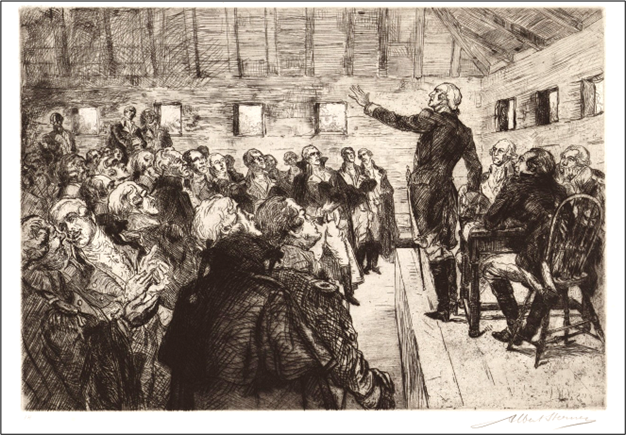
Washington allowed the meeting to convene in his absence, then strode in and asked to speak. In the process of reading a letter aloud, he put on a pair of spectacles, commenting that he had grown both gray and blind in service to his country. He continued:
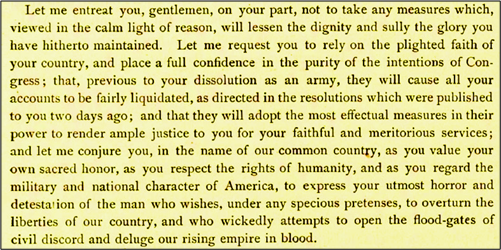
Let me entreat you, gentlemen, on your part, not to take any measures which, viewed in the calm light of reason, will lessen the dignity and sully the glory you have hitherto maintained. Let me request you to rely on the plighted faith of your country, and place a full confidence in the purity of the intentions of Congress; that, previous to your dissolution as an army, they will cause all your accounts to be fairly liquidated, as directed in the resolutions which were published to you two days ago; and that they will adopt the most effectual measures in their power to render ample justice to you for your faithful and meritorious services; and let me conjure you, in the name of our common country, as you value your own sacred honor, as you respect the rights of humanity, and as you regard the military and national character of America, to express your utmost horror and detestation of the man who wishes, under any specious pretenses, to overturn the liberties of our country, and who wickedly attempts to open the flood-gates of civil discord and deluge our rising empire in blood.
But was even this eloquent, moving appeal to honor and country enough to defuse the crisis? It was not; Congress needed once again to be physically threatened in order to discern the interests of the nation in their proper light.
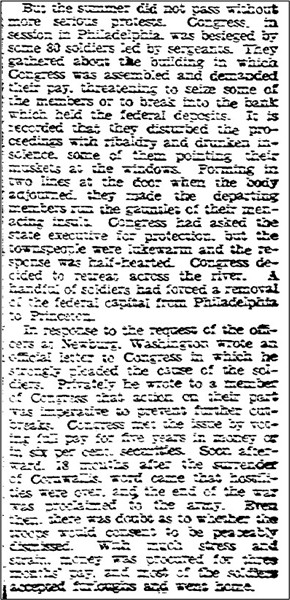
But the summer [of 1783] did not pass without more serious protests. Congress, in session in Philadelphia, was besieged by some 80 soldiers led by sergeants. They gathered about the building in which Congress was assembled and demanded their pay, threatening to seize some of the members or to break into the bank which held the federal deposits. It is recorded that they disturbed the proceedings with ribaldry and drunken insolence, some of them pointing their muskets at the windows. Forming in two lines at the door, when the body adjourned, they made the departing members run the gauntlet of their menacing insult. Congress had asked the state executive for protection, but the townspeople were lukewarm and the response was half-hearted. Congress decided to retreat across the river. A handful of soldiers had forced a removal of the federal capital from Philadelphia to Princeton.
In response to the request of the officers at Newburg, Washington wrote an official letter to Congress in which he strongly pleaded the cause of the soldiers. Privately he wrote to a member of Congress that action on their part was imperative to prevent further outbreaks. Congress met the issue by voting full pay for five years in money or in six per cent securities. Soon afterward, 18 months after the surrender of Cornwallis, word came that hostilities were over, and the end of the war was proclaimed to the army. Even then, there was doubt as to whether the troops would consent to be peaceably dismissed. With much stress and strain, money was procured for three months' pay, and most of the soldiers accepted furloughs and went home.
Readers who are familiar with today's "No Kings" movement will agree that America is still dealing with this issue even as we celebrate our 250th anniversary. In that light, we should mention what has been called the "Prussian scheme." Prince Henry (Heinrich) of Prussia was the younger brother of Frederick the Great. He had many of the qualities and accomplishments people admired in George Washington: he was a skilled military commander, a prudent leader in civilian life, well educated, a Freemason like Washington. In 1786, as Americans struggled to hammer out a workable constitution, it occurred to some that perhaps a king wasn't such a bad idea after all. Since Washington refused to serve in that capacity, maybe Henry would.
Former president of the Continental Congress, Nathaniel Gorham of Massachusetts, prevailed upon General Friedrich von Steuben, who had served under both Washington and Prince Henry, to write a letter to his former countryman proposing the idea of Henry serving as America's king.
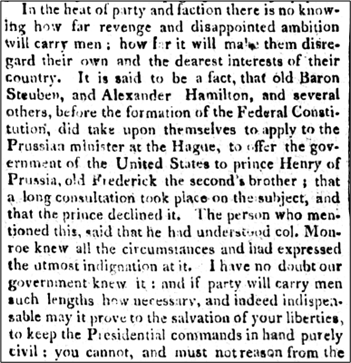
In the heat of party and faction, there is no knowing how far revenge and disappointed ambition will carry men; how far it will make them disregard their own and the dearest interests of their country. It is said to be a fact, that old Baron Steuben, and Alexander Hamilton, and several others, before the formation of the Federal Constitution, did take upon themselves to apply to the Prussian minister at the Hague, to offer the government of the United States to prince Henry of Prussia, old Frederick the second's brother; that a long consultation took place on the subject, and that the prince declined it. The person who mentioned this, said that he had understood col. Monroe knew all the circumstances, and had expressed the utmost indignation at it. I have no doubt our government knew it: and if party will carry men such lengths, how necessary., and indeed indispensable may it prove to the salvation of your liberties, to keep the Presidential commands in hand purely civil:
It may not have been a formal offer, but it certainly didn't come out of nowhere. Its reality was debated during confirmation proceedings of Massachusetts congressional delegate Rufus King to become Ambassador to Great Britain in 1825. It was said that King retained papers from the estate of Alexander Hamilton supporting allegations that such an offer had indeed been made to Prince Henry.
Nothing conclusive came to light until 1911 when author Richard Krauel published a draft of a letter discovered in a German archive from Prince Henry to von Steuben discussing this exact proposition, which the prince declined to indulge. The citation for the article appears below.

For that matter, Frederick, Duke of York, Bishop of Osnaburg and second son of Britain's King George III, was considered as a potential American sovereign in 1787. How's that for irony?
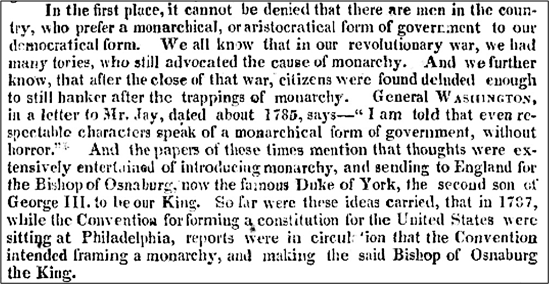
In the first place, it cannot be denied that there are men in the country, who prefer a monarchical, or aristocratical form of government to our democratical form. We all know that in our revolutionary war, we had many tories, who still advocated the cause of monarchy. And we further know, that after the close of that war, citizens were found deluded enough to still hanker after the trappings of monarchy. General WASHINGTON, in a letter to Mr. Jay, dated about 1785, says—'I am told that even respectable characters speak of a monarchical form of government, without horror.' And the papers of these times mentioned that thoughts were extensively entertained of introducing monarchy, and sending to England for the Bishop of Osnaburg, now the famous Duke of York, the second son of George III, to be our King. So far were these ideas carried, that in 1787, while the Convention for forming a constitution for the United States were sitting at Philadelphia, reports were in circulation that the Convention intended framing a monarchy, and making the said Bishop of Osnaburg the King.
In light of the vigorous, ongoing debate over civilian versus military rule and republican government versus monarchy extending over 250 years, Americans would do well to take seriously our responsibilities as citizens in honor of the real sacrifices our forebears suffered to afford us that opportunity.
First image source: Detail from "An original view of the encampment of the Massachusetts soldiers during the last year of the Revolutionary War" [By Pvt. William Tarbell, 1783.] Source: https://thechaplainkit.com