
A Continental Army Officer's Intemperate Remarks Lead to Duplicity and Duels in the Conway Cabal
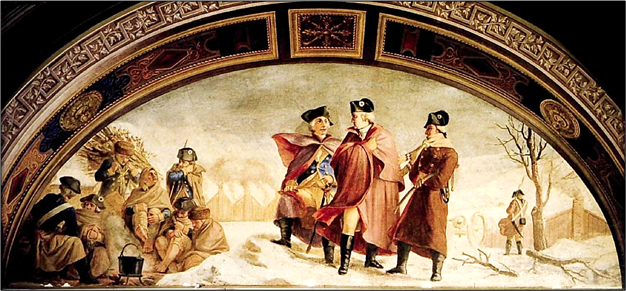
Students of American history are likely familiar with the conditions at Valley Forge, Pennsylvania during the winter of 1777-1778: shoeless soldiers leaving bloody tracks in the snow; rampant hunger and cold; the Continental Army's austere encampment just a few dozen miles from the amenities of what was then America's capital, Philadelphia, where the British Army was comfortably ensconced under General Sir William Howe. Who in their right mind would have looked at General George Washington's desperate circumstances at that time and said to himself or another, "Yeah, I really want that guy's job?"
Apparently, a number of ambitious officers entertained that very thought. A few gave voice to it or suffered others to promote their candidacy. One such person was General Horatio Gates, fresh off a victory over General John Burgoyne at Saratoga. Did that laurel belong at least equally to Major General Philip Schuyler? Never mind. The point is that according to many, Gates was ascendant, whereas Washington was on a losing streak.
Enough congressmen agreed with this outlook to appoint Gates to a Board of War and subsequently to a committee with explicit authority over Washington's actions. Also on that committee, Quartermaster General Thomas Mifflin, the man whose incompetence was primarily responsible for the wretched conditions at Valley Forge. Congress followed this by appointing General Thomas Conway as Inspector General of the Army, another powerful position. This story concerns the fateful words that Conway wrote to Gates about Washington—"Heaven has been determined to save your Country; or a weak General and bad Counsellors would have ruined it"—and what came of them.
Gates was an English army officer who retired to Virginia when his professional advancement was slow in coming. He developed anti-monarchy "Whig" attitudes while serving in the colonies. America's Continental Army needed experienced officers, and appointed Gates as a general in the Northern Department. Although he accepted Burgoyne's surrender at Saratoga in October 1777, Gates benefited greatly from Major General Philip Schuyler's overall campaign against the British in Canada and New York, and the initiative of General Benedict Arnold who had actually led the troops in the field during the battle while Gates remained at their headquarters.
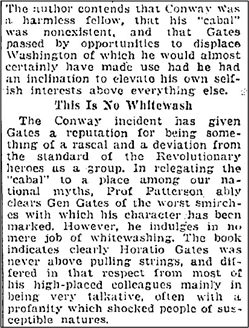
In a 1941 review of Samuel White Patterson's biography of Gates, the author described Patterson's exoneration of Gates as the architect of any plot to supersede Washington as commander-in-chief. The crux of his argument is that Gates had many opportunities to injure Washington's reputation, but did not avail himself of them.
The author contends that Conway was a harmless fellow, that his "cabal" was nonexistent, and that Gates passed by opportunities to displace Washington of which he would almost certainly have made use had he had an inclination to elevate his own selfish interests above everything else.
The Conway incident has given Gates a reputation for being something of a rascal and a deviation from the standard of the Revolutionary heroes as a group. In relegating the "cabal" to a place among our national myths, Prof. Patterson ably clears Gen. Gates of the worst smirches with which his character has been marked. However, he indulges in no mere job of whitewashing. The book indicates clearly Horatio Gates was never above pulling strings, and differed in that respect for most of his high-placed colleagues mainly in being very talkative, often with a profanity which shocked people of susceptible natures.
Source: Early American Newspapers, 1690-1922
Yet correspondence and attitudes at the time suggested Gates' tacit approval if not outright advocacy of the project. It featured prominently in letters by partisans of both Washington and Gates. The Marquis de Lafayette acknowledged it publicly and privately. The stakes were high enough that both Gates and Conway were challenged to duels because of it.
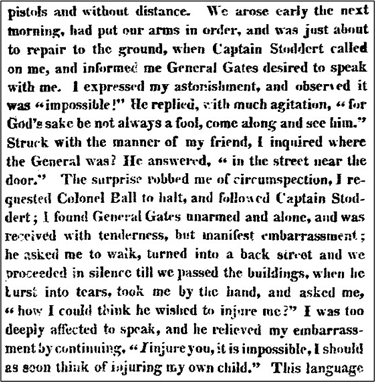
In Gates' case, the challenge was proffered by his own aide-de-camp, Adjutant General James Wilkinson, in response to Gates' accusation that Wilkinson was lying about Gates' involvement in the conspiracy. According to Wilkinson's memoirs, just prior to commencing that duel, Gates drew Wilkinson aside, burst into tears, and appealed to Wilkinson's charity to avoid meeting him on the field of honor. In behaving so he either proved his cowardice or acknowledged his complicity in the cabal—perhaps both. Readex's Early American Imprints, Series II (Shaw-Shoemaker, 1801-1819) includes Wilkinson's 1816 memoirs in three volumes. They're very interesting reading.
We arose early the next morning, had put our arms in order, and was just about to repair to the ground, when Captain Stoddart called on me, and informed me General Gates desire to speak with me. I expressed my astonishment, and observed it was "impossible!" He replied, with much agitation, "for God's sake, be not always a fool, come along and see him." Struck with the manner of my friend, I inquired where the General was? He answered, "in the street near the door." The surprise robbed me of circumspection, I requested Colonel Ball to halt, and followed Captain Stoddart; I found General Gates unarmed and alone, and was received with tenderness, but manifest embarrassment; he asked me to walk, turned into a back street and we proceeded in silence till we passed the buildings, when he burst into tears, took me by the hand, and asked me, "how I could think he wished to injure me?" I was too deeply affected to speak, and he relieved my embarrassment by continuing, "I injure you, it is impossible, I should as soon think of injuring my own child."
Source: Early American Imprints, Series II: Shaw-Shoemaker, 1801-1819
Thomas Conway was a native of Ireland appointed Brigadier General in America in May 1777 based upon prior service in France. Conway served with distinction at Brandywine and Germantown, both battles which Washington lost to Howe. When Conway lobbied Congress for promotion to Major General, Washington opposed it, in part because Conway would have jumped ahead of longer-serving officers with better claims. This was a perceived slight that Conway could not let go. He may not have originated the attempted coup that has come to bear his name, but he certainly sought to accelerate it, and largely from personal motives rather than any sense of honor or duty to American independence.
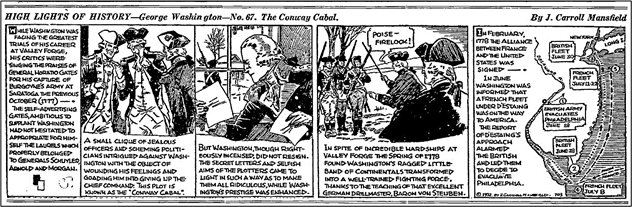
What happened was essentially the following: while Gates was basking in the glory of accepting Burgoyne's surrender at Saratoga, many discouraged officers and politicians latched onto him as the savior of the American cause. Officers such as Conway attached their hopes and ambitions to Gates at Washington's expense, and made sure Gates knew about it. The trouble is, Washington was still commander-in-chief, so a shift in allegiance to Gates was tantamount to insubordination, perhaps even to treason depending on how things played out.
Source: Early American Newspapers, 1690-1922
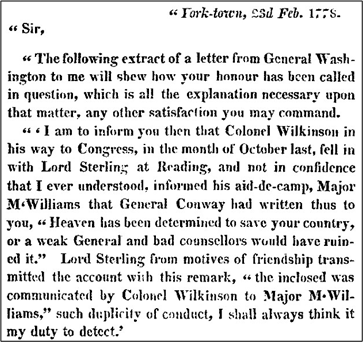
It so happened that Gates sent Wilkinson to carry some correspondence to Congress at York, during which trip Wilkinson stayed the night at Major General William Lord Stirling's camp in Reading, Pennsylvania. Wilkinson, a charming, roguish fellow, apparently drank too much and shared the gossip he had heard about Gates superseding Washington—including the explicitly disloyal quotation from Conway's letter. Lord Stirling relayed this intelligence to Washington, who in turn conveyed it back to Conway in a letter bearing Washington's seal but without further comment. Then the finger-pointing and denials began. The excerpt below comes from a letter from Gates to Wilkinson impugning the latter's honor in breeching his confidence:
Sir,
The following extract of a letter from General Washington to me will shew you how your honour has been called in question, which is all the explanation necessary upon that matter, any other satisfaction you may command.
"I am to inform you then that Colonel Wilkinson in his way to Congress, in the month of October last, fell in with Lord Sterling at Reading, and not in confidence that I ever understood, informed his aid-de-camp, Major M'Williams that General Conway had written thus to you, "Heaven has been determined to save your country, or a weak General and bad counsellors would have ruined it." Lord Sterling from motives of friendship transmitted the account with this remark, "the inclosed was communicated by Colonel Wilkinson to Major M'Williams," such duplicity of conduct, I shall always think it my duty to detect."
Source: Early American Imprints, Series II: Shaw-Shoemaker, 1801-1819
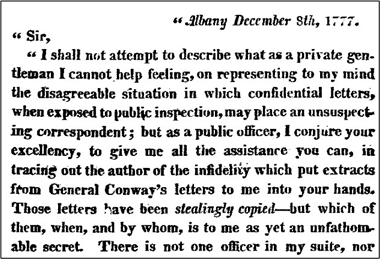
Washington wisely stayed above the fray while his rivals destroyed each other. Conway appealed to Gates for support. Gates began not by challenging the content of the letter or his relation to it, but by asserting that it had been "stealingly copied" by none other than Alexander Hamilton, a solid supporter of Washington. Then he claimed that another staff officer, Colonel Robert Troup, must have communicated the contents of the letter to Colonel Hamilton, who subsequently leaked them. This excerpt is from Gates to Washington:
I shall not attempt to describe what as a private gentleman I cannot help feeling, on representing to my mind the disagreeable situation in which confidential letters, when exposed to public inspection, may place an unsuspecting correspondent; but as a public officer, I conjure your excellency, to give me all the assistance you can, in tracing out the author of the infidelity which put extracts from General Conway's letters to me into your hands. Those letters have been stealingly copied—but which of them, when, and by whom, is to me as yet an unfathomable secret.
Source: Early American Imprints, Series II: Shaw-Shoemaker, 1801-1819
When that didn't find traction, Gates insisted that the letter was fraudulent and that Wilkinson's drunken gossip was false as well, prompting the abortive duel described above. Then he claimed that Conway had said even worse things to Washington in person, so the letter was benign by comparison. And that there was just the one letter, except he had already referred to "letters," plural, above.
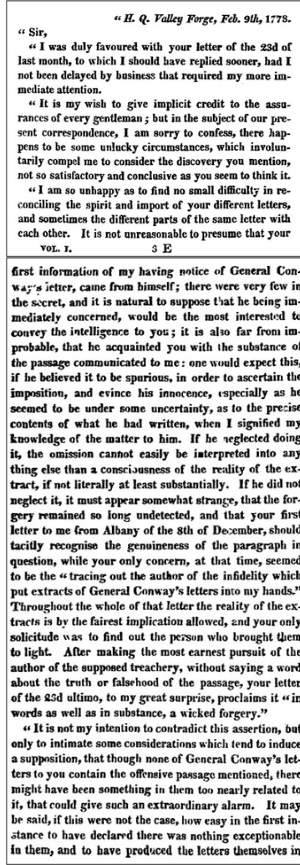
In the midst of his floundering, Gates copied his denials to Congress in a quest for support from that body. None was forthcoming; just months after authorizing that a gold medal be struck for him as the victor of Saratoga, Congress let him take the fall for their collective sins. Washington just let him go on incriminating himself before winding him up in a letter of February 9, 1778.
It is my wish to give implicit credit to the assurances of every gentleman; but in the subject of our present correspondence, I am sorry to confess, there happens to be some unlucky circumstances, which involuntarily compel me to consider the discovery you mention, not so satisfactory and conclusive as you seem to think it.
I am so unhappy as to find no small difficulty in reconciling the spirit and import of your different letters, and sometimes the different parts of the same letter with each other. It is not unreasonable to presume that your first information of my having notice of General Conway's letter, came from himself; there were very few in the secret, and it is natural to suppose that he being immediately concerned, would be the most interested to convey the intelligence to you; it is also far from improbable, that he acquainted you with the substance of the passage communicated to me: one would expect this, if he believed it to be spurious, in order to ascertain the imposition, and evince his innocence, especially as he seemed to be under some uncertainty, as to the precise contents of what he had written, when I signified my knowledge of the matter to him. If he neglected doing it, the omission cannot easily be interpreted into anything else than a consciousness of the reality of the extract, if not literally at least substantially. If he did not neglect it, it must appear somewhat strange, that the forgery remained so long undetected, and that your first letter to me from Albany of the 8th of December, should tacitly recognise the genuineness of the paragraph in question, while your only concern, at that time, seemed to be the "tracing out the author of the infidelity which put extracts of General Conway's letters into my hands." Throughout the whole of that letter, the reality of the extracts is by the fairest implication allowed, and your only solicitude was to find out the person who brought them to light. After making the most earnest pursuit of the author of the supposed treachery, without saying a word about the truth or falsehood of the passage, your letter of the 23d ultimo, to my great surprise, proclaims it "in words as well as in substance, a wicked forgery."
It is not my intention to contradict this assertion, but only to intimate some considerations which tend to induce a supposition, that though none of General Conway's letters to you contain the offensive passage mentioned, there might have been something in them too nearly related to it, that could give such an extraordinary alarm.
Source: Early American Imprints, Series II: Shaw-Shoemaker, 1801-1819
The end result was that the officers and congressmen opposing Washington were shown to be petty and malicious, sniping at him from a comfortable distance with the benefit of hindsight, while Washington was daily out in the field sharing the hardships of his troops, trying strenuously to prepare for a successful spring campaign.
By not attacking the British army under Howe while it was in Philadelphia, Washington bought sufficient time for Baron Friedrich Wilhelm von Steuben to whip the Continental Army into shape following Frederick the Great's Potsdam Discipline regimen. When Benjamin Franklin fielded a question in Paris about Howe's capture of Philadelphia in 1777, he replied, "Howe has not taken Philadelphia. Philadelphia has taken Howe."
Gates would eventually demonstrate the limits of his military ability when he was soundly defeated by Cornwallis at Camden, South Carolina in 1780. Congress removed Gates from command, and he was eventually placed on Washington's staff. His career of opposing Washington was not yet concluded, however, as he supported threats of mutiny by the troops in Newburgh, New York in 1783 over Congressional inaction relative to military demands.
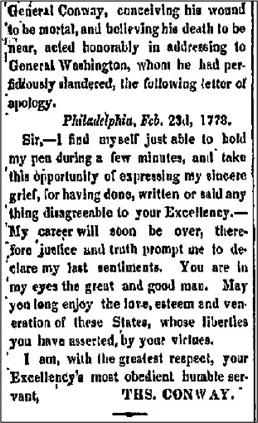
Any lingering doubts regarding the seriousness of the Conway Cabal should be put to rest by Conway's own written apology to Washington when the former suffered a potentially life-threatening head injury, the result of a duel on July 4, 1778, with General John Cadwalader over Conway's slander of Washington. Conway shot first and missed. Cadwalader then took careful aim and literally shot Conway's mouth off. It's hard not to view this as poetic justice.
Sir,—I find myself just able to hold my pen during a few minutes, and take this opportunity of expressing my sincere grief, for having done, written or said anything disagreeable to your Excellency.—My career will soon be over, therefore justice and truth prompt me to declare my last sentiments. You are in my eyes the great and good man. May you long enjoy the love, esteem. And veneration of these States, whose liberties you have asserted, by your virtues.
I am, with the greatest respect, your Excellency's most obedient humble servant, THS. CONWAY.
Source: Early American Newspapers, 1690-1922
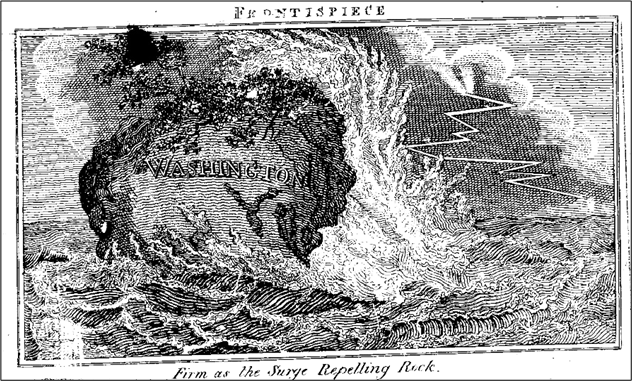
The life of George Washington… By David Ramsay, M.D. 1815.
Source: Early American Imprints, Series II: Shaw-Shoemaker, 1801-1819