The story of America’s Indigenous peoples is rich and varied — a complex tapestry of achievements, dislocations, occupations, resistance, forced migrations, upheavals, and triumphs that have shaped American society and the American identity. Indigenous Life in America offers researchers an expansive window into the epic sweep of Indigenous history, providing unmatched coverage of the entire spectrum of the Native experience from the earliest records to current times.
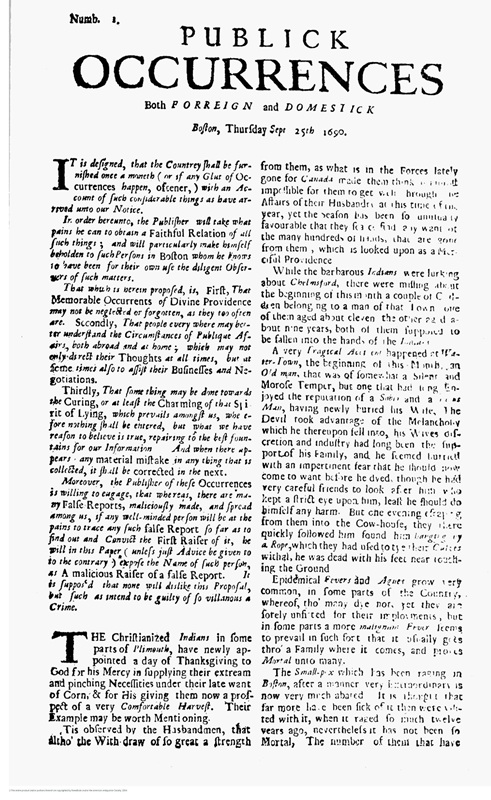
Indigenous Life in America is the largest and most comprehensive digital news archive ever assembled covering Native American life. The collection begins in 1690 with the first issue of Americas’ first newspaper, Publick Occurrences. More than 17,500 content sources address all time periods, geographies, and localities where Native life has been documented. Navigation tools facilitate quick and easy access to the full collection and to topic categories such as activism, arts, court decisions, education, Indigenous government, health, reservations and removal, sports, and many others.
Students seeking background and context will find the collection easy to navigate using Suggested Searches as well as categorization by important Eras (for example, “Indian Citizenship Act to Iwo Jima,” 1924-1945). Advanced users will benefit from the collection’s depth, completeness and ability to support research across multiple disciplines, including anthropology, history, literature, sociology, political science, cultural studies, religious studies, Native American Studies, Alaska Native Studies, Pacific Islander Studies, and more.
Given the wide variety of cultural groups that constitute Native Americans, Indigenous Life in America takes exceptional care to establish tribal identities accurately — a critical value-add for researchers who require precision when exploring a specific tribe or people group or when drawing comparisons between tribal nations.
To facilitate research, the collection is divided into three stand-alone modules:
Series 1: 1690-1945: European Colonization through World War II. This digital archive explores Indigenous life from the arrival of European settlers through the end of World War II. Researchers will find varied perspectives on subjects such as the Louisiana Purchase, Fletcher v. Peck, Indian Civilization Act, Medicine Lodge Treaty, Indian Removal Act, Carlisle Indian Industrial School, Hawaiian Kingdom leprosy outbreak, annexation of Hawaii, Wounded Knee massacre, California Gold Rush, “Song of Hiawatha,” American Indian sign language, and much more.
Series 2: 1946-2016: Indigenous Identity after World War II. Series 2 documents the losses and gains of Indigenous peoples as they struggled to re-establish their identity and influence in the decades after World War II. This series contains coverage of hundreds of events, people, and topics, including: Code Talkers, Red Power Movement, the Native fight for the vote, Trail of Broken Treaties, Sacred Site Protection, Tribal Nations Conference, Longest Walk of 1978, mascot controversy, and many others.
Series 3: 2017-Today: Indigenous Americans in the twenty-first century. Available as a subscription from NewsBank. For more information, visit newsbank.com.