
Sorry, you need to enable JavaScript to visit this website.
Skip to main content

The Holy Ghosters: Maine's Forgotten Turn-of-the-Century Cult

Posted on 05/21/2026
by

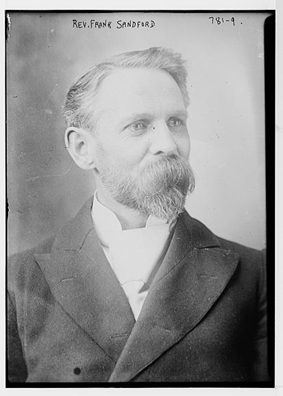
Most of us have wondered if we possess the charisma required to lead a movement; most of us don't. Rev. Frank W. Sandford did. 
Image
Black-and-white portrait photograph of a middle-aged man identified as Rev. Frank Sandford. He has short light-colored hair, a full beard and mustache, and wears a dark suit jacket with a high white collar. He is posed in three-quarter profile, looking slightly upward and away from the camera.
Rev. Frank Sandford. From the Library of Congress.

In 1896, his trajectory from magnetic preacher to federal prisoner began. The grandson of a country minister, Sandford converted to the Baptist faith around 1880. He later attended Nichols Latin School, Bates College, and Cobb Divinity School. By 1886, he had left his studies to serve as a student pastor at the Free Will Baptist Church in Topsham, Maine.

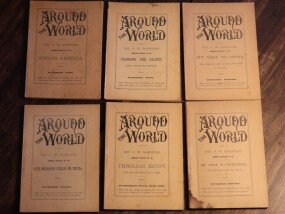
His second ministry was in Great Falls, New Hampshire. The church flourished under his leadership and even financed his first global missionary voyage. He chronicled this journey in a 6-volume booklet series titled, Around the World. 
Image
Six worn vintage booklets titled “Around the World” are arranged in two rows on a dark surface. The tan covers feature decorative black lettering and subtitles for different issues or topics. The booklets show signs of age, including creases, discoloration, and frayed edges.
Around The World by Rev. F. W. Sandford, 7 Parts in 6 Volumes, 1890-91 Shiloh VG. From https://www.vialibri.net/

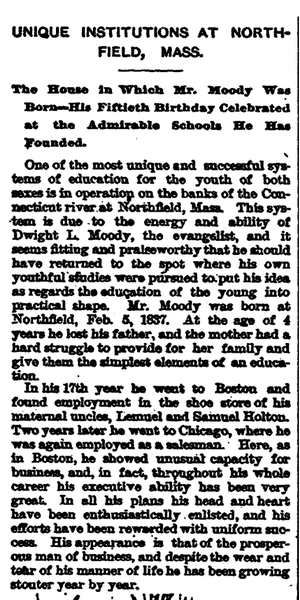
Beginning in 1887, after attending a conference hosted by the Student Volunteers Missionary Movement at Dwight L. Moody's school in Massachusetts, Sandford's theological views began to shift. He felt mounting pressure to put his faith into action, specifically through foreign ministries. This article from the Trenton Evening Times explains not only Moody's background and influence as a minister, but also the teachings influencing Sandford's thinking.
Image
Narrow black-and-white newspaper clipping titled “Unique Institutions at North Leeds, Maine.” The article describes religious and educational buildings
Click image to view full article. Trenton Evening Times, Trenton, New Jersey, February 20, 1887. From Early American Newspapers, 1690-1922. 

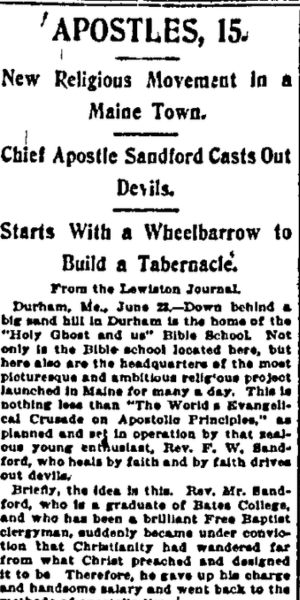
Upon returning to Maine in 1896 from a country-wide ministry tour he claimed a divine calling to establish a Bible school on a sandy hill in Durham. Despite having no capital and adhering to a philosophy of "owe no man," construction began. Supporters soon contributed funds and labor to the cause. 
Image
Tall black-and-white newspaper page featuring a long article with the headline beginning “Apostles, 15…” and discussing a religious sect connected to Maine and F. W. Sandford. The page is densely packed with narrow columns of text and minimal images, typical of early 20th-century newspaper formatting.
Click image to view full article. Boston Daily Advertiser, Massachusetts, June 24, 1896. From Early American Newspapers, 1690-1922

Before long, the Holy Ghosters' temple stood on the site, surrounded by a small, self-sufficient town. At its peak, this community, known as Shiloh, housed 600 residents and featured a school, greenhouses, several farms, a shoe factory, and a hospital.

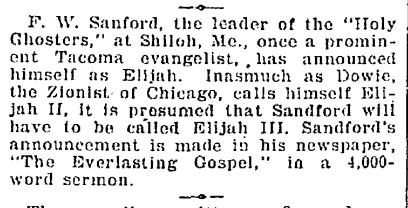
The church Sandford founded held several distinct beliefs. Beyond the "owe no man" debt-free philosophy, they practiced six hours of prayer every Thursday, the day they believed Jesus was crucified. They also adhered to British Israelism, asserting the "ten lost tribes" were in fact the British people. By claiming his decisions were divinely dictated, Sandford convinced followers he was the reincarnation of Elijah—a status that rendered his actions seemingly above reproach.
Image
Black-and-white newspaper clipping reporting on F. W. Sandford, leader of the “Holy Ghosters” at Shiloh, Maine. The article states that Sandford, once a Tacoma evangelist, proclaimed himself Elijah and references a sermon published in his newspaper, “The Everlasting Gospel.”
Seattle Daily Times, Seattle, Washington, January 17, 1902. From Early American Newspapers, 1690-1922

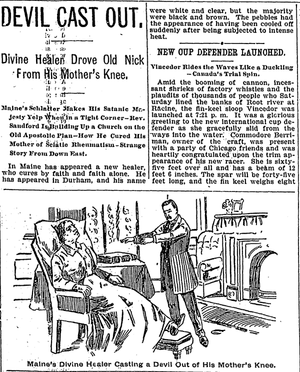
However, the more dangerous tenets involved extreme fasting and spiritual healing. Sanford taught that illness was the direct consequence of sin, and the only path to recovery was through prayer, the laying of hands, and fasting.
Image
Black-and-white newspaper page with the headline “Devil Cast Out.” The article describes a dramatic religious event connected to a sect in Maine and includes several illustrations, including a man speaking to seated listeners and smaller drawings of expressive figures. Dense columns of text fill most of the page in a traditional newspaper layout.
Click image to view full article. Saturday Blade, Chicago, Illinois, July 4, 1896. From Early American Newspapers, 1690-1922

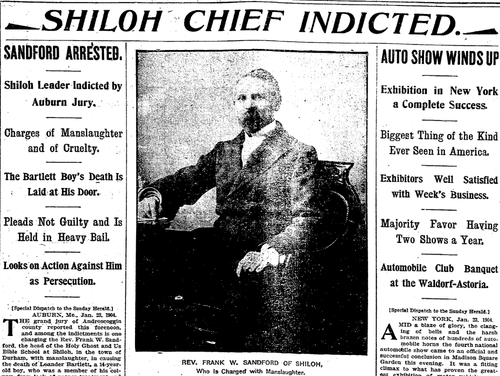
In 1903, Sandford initiated a "Nineveh Fast," prohibiting all food and drink for 36 hours—even for infants, the elderly, and the infirm. During one such fast, 14-year-old Leander Bartlett confessed to the "sin" of wanting to run away. He died of diphtheria shortly thereafter. Local sentiment turned against the church, and in 1904, Sandford was indicted for cruelty to children stemming from excessive fasting and manslaughter.
Image
Black-and-white newspaper front page featuring the headline “Shiloh Chief Indicted” above an article about Sandford. A portrait of a bearded man standing beside a chair appears near the top center. Multiple columns of dense text and additional headlines fill the rest of the page in a classic early newspaper layout.
Click image to view full article. Boston Herald, Massachusetts, January 24, 1904. From Early American Newspapers, 1690-1922

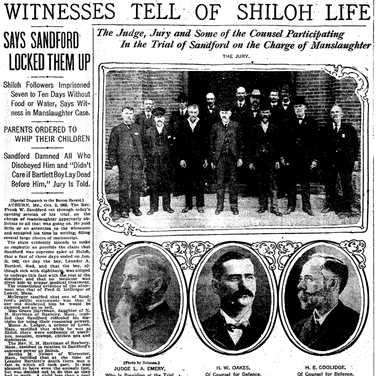
The coverage of the Holy Ghosters' crimes and beliefs shocked the country and made headlines as many different accounts of life in Shiloh began to emerge.
Image
Black-and-white newspaper page with the headline “Witnesses Tell of Shiloh Life.” The article discusses testimony in the Sandford manslaughter trial and includes a group photograph of men connected to the case, along with three oval portrait photos labeled with names and roles. Dense columns of text surround the images in a traditional newspaper layout.
Click image to view full article. Boston Herald, Massachusetts, October 6, 1905. From Early American Newspapers, 1690-1922

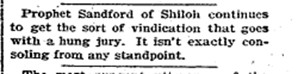
Sanford was initially convicted; the decision was reversed on appeal following a hung jury in 1905.
Image
Black-and-white newspaper clipping with a short printed paragraph about “Prophet Sandford of Shiloh.” The text comments on the public attention surrounding Sandford and references a hung jury in his case. The clipping is cropped closely around the article text.
Boston Herald, Boston, Massachusetts, October 9, 1905. From Early American Newspapers, 1690-1922

While still embroiled in legal battles, Sandford purchased a racing yacht named the Coronet. He made two trips to Jerusalem between 1905 and 1906.

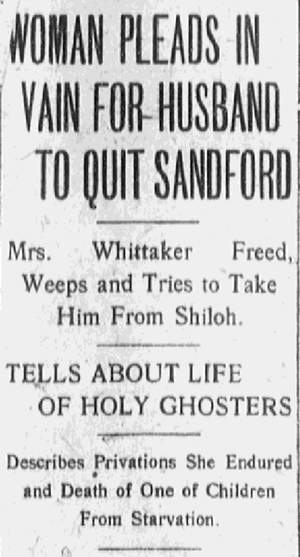
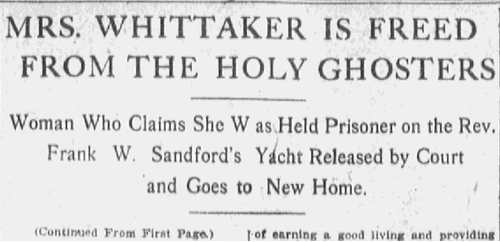
Before returning to Maine, Sandford learned a follower, Mrs. Florence Whittaker, wished to leave the Holy Ghosters. While she was granted passage back to the U.S., she was allegedly detained upon arrival until she agreed to remain with the group. Mrs. Whittaker eventually escaped and regained custody of her children through the court system.
Image
Black-and-white newspaper article with the headline “Woman Pleads in Vain for Husband to Quit Sandford.” The story describes testimony about life among the Holy Ghosters and the death of a child from starvation. Dense columns of text fill the narrow clipping in a traditional early newspaper style.
Image
Black-and-white newspaper article with the headline “Mrs. Whittaker Is Freed From the Holy Ghosters.” The story reports on a woman released from Rev. Frank W. Sandford’s religious colony after court action. Multiple columns of dense text describe her testimony and conditions within the group.
Click image to view full article. Boston Journal, Massachusetts, June 9, 1910. From Early American Newspapers, 1690-1922

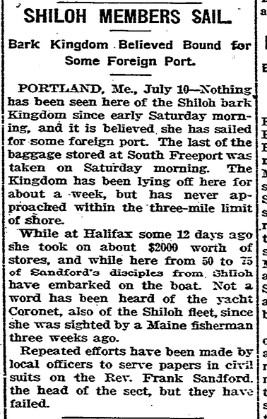
By this time, authorities were monitoring ports to serve Sandford with legal papers. To avoid accountability, he set sail for Africa and Greenland, claiming a mission to open churches in both regions. He took his followers aboard the Coronet with inadequate provisions and, claiming divine instruction to avoid U.S. and Canadian ports, he left Africa for Greenland without restocking supplies.
Image
Black-and-white newspaper clipping with the headline “Shiloh Members Sail.” The article reports that the bark Kingdom, associated with followers of Rev. Frank W. Sandford, left Portland and was believed bound for a foreign port. Dense columns of text describe the ship’s departure and failed attempts to serve legal papers.
Boston Herald, Boston, Massachusetts, July 11, 1910. From Early American Newspapers, 1690-1922

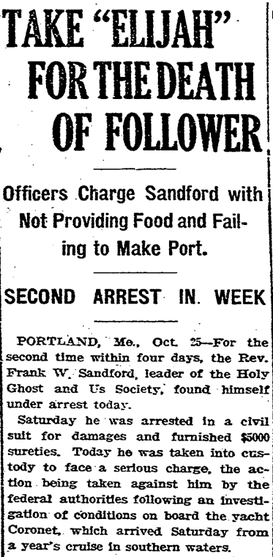
In September 1911, after narrowly avoiding a mutiny, the Coronet turned south. The crew was saved from starvation only by the S.S. Lapland who provided them with more rations. However, the Lapland lacked fresh produce, and by late October six crew members had succumbed to scurvy, dying just days before the ship reached Portland, Maine on October 21, 1911. Sandford was arrested first for the unlawful detention of Mrs. Whittaker and second for crewmembers' deaths. One wonders if his previous success in evading justice led to this tragic conclusion.
Image
Black-and-white newspaper article with the headline “Take ‘Elijah’ for the Death of Followers.” The story discusses officers charging Sandford with neglect after followers reportedly died from lack of food and care aboard a ship. The narrow clipping contains dense columns of text in an early newspaper format.
Click image to view full article. Boston Herald, Massachusetts, October 26, 1911. From Early American Newspapers, 1690-1922

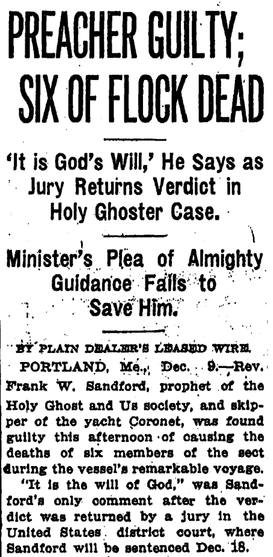
Sandford refused legal counsel arguing in court that the illness on the ship was divine punishment for the sin of rebelling against him. The jury took less than an hour to convict him. On December 17, 1911, he was sentenced to a federal penitentiary in Atlanta, Georgia.
Image
Black-and-white newspaper clipping with the headline “Preacher Guilty; Six of Flock Dead.” The article reports that Rev. Frank W. Sandford was found guilty in connection with deaths among his followers aboard the ship Kingdom. Dense columns of text describe courtroom testimony and reactions to the verdict.
Click image to view full article. Plain Dealer, Cleveland, Ohio, December 10, 1911. From Early American Newspapers, 1690-1922

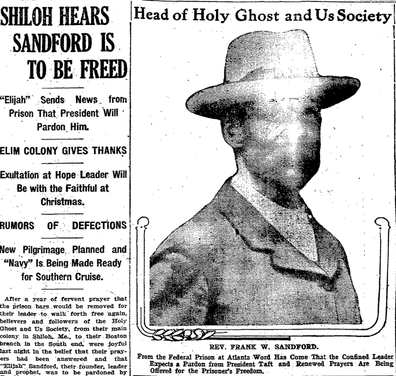
He viewed his incarceration as God's will and continued to minister to fellow inmates, teaching many to read and write. While he was imprisoned, his authority waned though his most devout followers awaited his return, finally celebrating his release almost seven years later.
Image
Black-and-white newspaper front page featuring the headline “Shiloh Hears Sandford Is to Be Freed.” A large portrait of Frank W. Sandford wearing a wide-brimmed hat appears near the top center. Additional headlines and dense columns of text discuss legal proceedings, rumors, and events connected to the Shiloh religious movement.
Click image to view full article. Boston Herald, Boston, December 8, 1912. From Early American Newspapers, 1690-1922

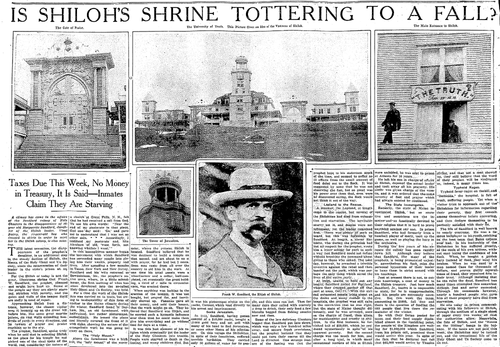
In the years after his release his son, John, who was the Holy Ghosters heir apparent, failed to wield the same influence as his father. Even Sandford's 15-year-old daughter Marguerite fled the community.
Image
Black-and-white newspaper front page with the headline “Is Shiloh’s Shrine Tottering to a Fall?” The page includes several photographs of buildings, a doorway with a “The Truth” sign, and a portrait of Frank W. Sandford. Multiple columns of text discuss financial troubles and conditions at the Shiloh religious community in Maine.
Click image to view full article. Boston Herald, Boston, February 13, 1916. From Early American Newspapers, 1690-1922

As the years passed, Shiloh began to dissolve due to poverty and starvation. It was only then Sandford claimed to receive a heavenly message to retire. By 1921, Shiloh was all but deserted. 
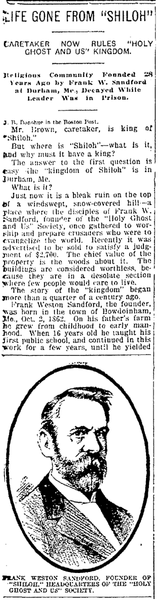
Image
Tall black-and-white newspaper page featuring an article about “Shiloh” and Rev. Frank W. Sandford. The layout includes dense columns of text, an oval portrait illustration of a bearded man, a small cartoon drawing near the top, and an advertisement near the bottom. The page follows a traditional early newspaper design with tightly packed content.
Click image to see full article. Kansas City Times, Missouri, December 26, 1921. From Early American Newspapers, 1690-1922

Sanford spent the remainder of his life in seclusion and prayer before passing away on March 4, 1948.

The story of Frank Sandford and the "Holy Ghost and Us" movement serves as a chilling case study in the dangers of unchecked authority. What began as a zealous mission to evangelize his gospel around the world spiraled into a tragedy of isolation and neglect. Sandford's downfall left a haunting mark on American religious history and is a somber reminder of the thin line between spiritual devotion and madness. 


Early American Newspapers, 1690-1922 chronicles American culture and religion from the Puritans and early Jewish and Muslim colonists through the rise and fall of separatists religious movements into the early 20th century.  

Stay in Touch

Receive Readex news, invitations, and special offers

Sign Up

By clicking "Sign Up", you acknowledge that you have read and understand our Privacy Policy and Terms of Use.